
The Data Foundation Behind Dreamdata AI
AI agents give you an answer whether or not it’s correct. But when it comes to your quarterly business review, you need to be able verify how it got that answer so you can trust it.
We’re already seeing B2B marketing teams move their analytics work into agents like Claude, ChatGPT, and Gemini, and for good reason: it takes the busywork off your plate so a small team performs like a big one.
You can connect your go-to-market data and ask questions in plain English instead of waiting on answers from a data analyst.
Every agent hands out fast, confident answers. What’s missing is a way to trust the answers that come back to you.
That’s the philosophy behind Dreamdata AI, get the data model right first and every answer the AI gives holds up.
This relies on three things: your unique go-to-market context, a governed semantic layer, and a clear way to verify every answer, so you can trust what comes back and know what to do next.
In this blog, we’ll break down:
What You Lose When LLMs Do the Work
Using LLMs for analytics often means offloading work you used to do yourself. Instead of pulling data from different platforms, fighting spreadsheets, building reports, and double checking the numbers every step of the way, you prompt your preferred agent and get a quick answer.
As James Dietrich, Dreamdata’s CTO, puts it: when you’re building the report yourself and pulling the data at every step, “you’re involved in verifying the correctness of the answer.”
Delegate that to an agent instead and “you’re not involved in the process, you only see the output.”
So the process that used to be traceable, step by step, is now invisible.
Your go-to-market data – every touchpoint, every account, every deal – is far too large to fit inside an agent’s context window. Rebuild all of that yourself from raw data sources every time you ask a question and you burn through cost without ever getting the full picture.
If you ask an agent to produce marketing’s influence on pipeline ahead of a quarterly business review and, as James explains, “you actually don’t know the answer ahead of time.” Which is where the credibility risk comes in: you need to be able to verify the answer.

The number it returns is a black box: no logic to check, no way to understand exactly where it came from. Does it count revenue? Is it a closed-won opportunity? Does it calculate the answer the same way every time or do you have to remind it with every prompt?
You don’t get an answer to any of those questions, just the number. And that’s a hard thing to defend in front of leadership if someone asks how it's calculated.
What Dreamdata AI is Built On
AI is only as good as the data behind it. And raw data isn’t ready for analysis or agent action on its own; it has to be organized and defined first (something you’d usually ask a data analyst to do if you weren’t using AI).
“You can’t bolt on trust in AI after the fact,” James explains. “It actually has to be built into how the data is accessed and which data the AI has access to from the very beginning.”
Which is why we built the foundation for the model first. For AI answers you can stand behind, the data model needs three things:
Your unique go-to-market context
Before AI ever answers a question, Dreamdata’s account-based data model has already defined what counts as a touchpoint, mapped to a customer journey, and connected spend to revenue, all within your company’s go-to-market context.
Having this defined “ensures that the AI isn’t reinventing the wheel every single time you ask a question about marketing’s performance.”
It’s one set of rules for every account, so a touchpoint means the same thing everywhere across the platform, not something each team ends up defining in their own way. And it covers every channel and tool in one place, connected from the start.
So when you ask a question, the agent (ours or yours) isn’t guessing at any of that.
Because every touchpoint is organized and tied to your actual funnel, it can answer from the full picture of how an account moved from first touch to closed-won instead of piecing the story together from raw data.

Consistent definitions and calculations
Point an agent straight at a raw database and it has to guess which fields mean what.
Dreamdata’s semantic layer removes that guesswork.
It works as a rulebook that already knows what every metric means (leads, channels, pipeline stages, which activities led to a closed-won deal) with one official definition, set once. So a lead means the same thing whether you’re building the report yourself or asking the AI to build it for you.
Many semantic layers stop at definitions. Dreamdata’s takes it a step further by also knowing the right way to analyze every metric through our library of proven analyses: attribution from first-touch to revenue, channel and campaign performance, spend efficiency, how accounts move through the funnel.
In practice, that means the agent understands the question you’re asking and (instead of figuring out the math itself) picks the right analysis for it. The number is calculated the same proven way every time, so no matter how the question is phrased or by whom, the answer comes out the same.
A clear way to verify the output
Whether you build the report with Dreamdata Analytics Agent or with your preferred LLM using the Dreamdata MCP Server, you can see exactly what a number was built on by opening the report configurator on Dreamdata.
The metrics, filters, date range, and attribution model behind it are all there to verify where the numbers came from.
For Custom Agents on Dreamdata’s Data Warehouse, the account-based data model is exported with the analytics already built directly into the schema: every table and field is explained, as well as how they connect and how to query them correctly.
Point your own agent at the warehouse and it inherits that structure, instead of trying to reconstruct meaning from raw data. So it reads the model correctly and your team has a clear reference to verify what it built.
“B2B marketers shouldn’t have to blindly trust software. We want to give them the power to verify what an AI tool says, so they don’t have to second-guess themselves.”
— James Dietrich, CTO, Dreamdata
No matter which Dreamdata AI offering you’re using, you never have to guess where a number came from.
Wherever You Work, Dreamdata AI Meets You There
Because we built the model first, it works with any AI agent, ours or your own.
Normally, James describes, “you either hand everything to a vendor and lose all control or you do everything yourself and lose any guardrails a vendor might have.” We don’t think you should have to choose.
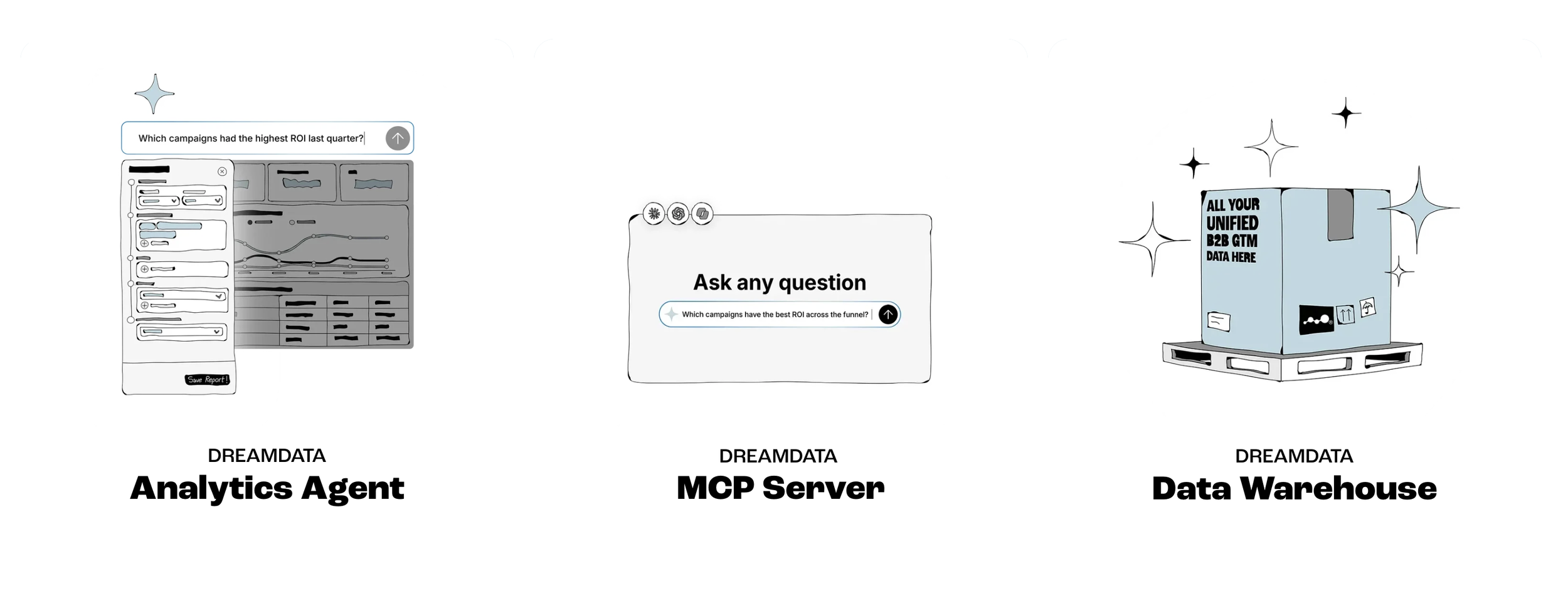
All three offerings stand on the same foundational data model. The choice between them depends on how much flexibility you’d like, where you prefer to work, and who takes responsibility for the analysis.
Where Dreamdata runs it, we back the results. Where you bring your own AI, you get the same complete go-to-market data foundation, with the analytics already built into it, and you own how your AI uses it.
Dreamdata Analytics Agent is the most guided option. Dreamdata takes responsibility for what it produces.
Dreamdata MCP Server is a middle ground: Dreamdata’s data model and semantic layer (just like the Analytics Agent), brought into the LLM your team already uses, with verification through Dreamdata’s report configurator.
Custom Agent on Dreamdata’s Data Warehouse gives you the same account-based data model, fully documented, for building your own custom agents with full control and full responsibility for verification.
Find a full breakdown of all three Dreamdata AI offerings here →
Conclusion
Point an agent at your go-to-market data directly and it has to guess what your business’ context is. It doesn’t know what counts as a touchpoint or how accounts move through your funnel. It can give you an answer, but not a clear way to verify how it got there.
Dreamdata AI closes those gaps with one foundation: your own go-to-market context instead of a guess, a governed semantic layer that keeps the definitions consistent, and a way to verify every answer.
As AI becomes a bigger part of B2B marketing analytics, the account-based data model behind it will matter just as much as the AI itself.
