
TL;DR: B2B marketers build awareness long before buyers request a demo, but Sales Development teams often lack that context when they reach out. We use Dreamdata Signals and Engagement Score to identify and prioritize engaged accounts and tailor messaging to what buyers show interest in.
An unknown number rings, you pick up, and someone starts talking about a brand you’ve never heard of.
Chances are, you’re already thinking about hanging up.
But replay that same call: same SDR, same opener. Only this time, you’ve already seen the brand’s content, watched a video, downloaded a report, and visited their pricing page – twice.
That’s a call that tends to go differently.
The difference is what happens before the phone rings. Buyers are reading your content and seeing your ads long before they’re ready to speak to sales. And for sales development teams, knowing which accounts are showing interest can change who they call, when, and what they say in that first conversation.
In a recent episode of the Attributed Podcast, our CMO and co-founder Steffen Hedebrandt sat down with Julian Muniz, our Global Senior Director of Sales Development, to walk through how we’ve brought marketing and sales development together to reach accounts earlier in their buying journey.
Keep reading for a closer look at our outbound approach and what your team can take from it, or listen to the full conversation here.
Why We Moved From Inbound to Allbound
For most of Dreamdata’s eight-year history, inbound drove the majority of sales opportunities. We’ve built a strong marketing engine that helps buyers discover us and brings them to sales when they’re ready for a conversation.
But we also know that potential customers engage with Dreamdata long before requesting a demo. (The customer journey is kind of our thing.)
Our 2026 LinkedIn Ads Benchmarks Report found that 81% of the B2B buying journey happens before an opportunity enters the sales pipeline. That’s a lot of time for buyers to get to know your brand before they’re ready to talk.
So, earlier this year, we grew our SDR team and started building an allbound approach.
Allbound brings inbound and outbound together. Marketing continues to create awareness and engage target accounts, while sales development uses that activity to start conversations earlier. Both teams work from the same account engagement data to decide who is worth pursuing, rather than treating inbound and outbound as separate motions.
As Julian explains: “We’re penetrating accounts earlier before they actually put in for a demo request … [The marketing team gives] me the intent data I need to be able to know when to do that via Signals.”
Within six months, the sales development team was contributing approximately two-thirds of Dreamdata’s new pipeline creation.
Our SDRs build on the awareness and interest marketing has already created, starting conversations with accounts that are already familiar with Dreamdata, rather than approaching them cold.
Of course, that only works if the team knows which accounts are worth pursuing in the first place.
How to Know Which Accounts to Prioritize
The tricky thing about buyer engagement is that there’s usually plenty of it. And figuring out which activities suggest an account might be worth talking to is another matter. Luckily, we had a pretty good starting point: our own customer journey data.
In Dreamdata, we can see when accounts visit our website, see an ad, download our Benchmarks report, click through a newsletter, or attend an event. But not every one of those interactions is a reason to pick up the phone.
So, our marketing and the sales development teams collaborated to decide which activities were worth paying attention to.
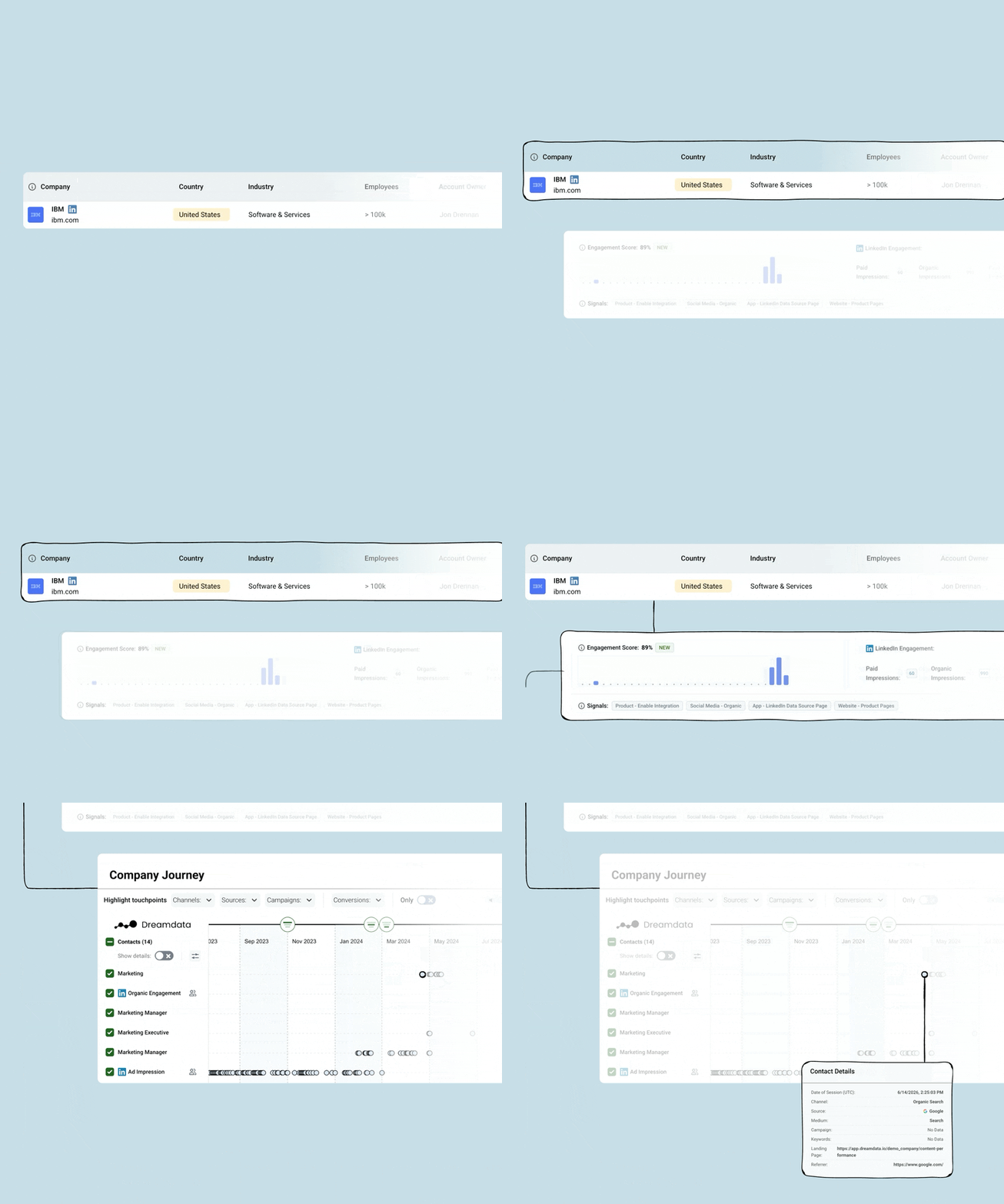
We started with Dreamdata Signals, which uses AI to scan your go-to-market data and identifies patterns that correlate with buying intent. From there, we manually customized those signals based on what we already know about our own customers and how they buy.
So, our SDRs can spot accounts showing intent without digging through every customer journey themselves.
“You can either take somebody who’s ice cold and try and convince them or you can take those that already know about Dreamdata … and try to talk to them with all the context that you have on this account instead,” Steffen describes.

Why One Signal Rarely Tells the Whole Story
Of course, someone visiting a pricing page doesn’t necessarily mean they’re ready for a sales conversation.
Which is why we also use the Engagement Score.
Dreamdata combines the selected signals into an account-level score. Teams can add their own custom signals and decide which activities carry more weight.
“It doesn’t have to be that somebody’s looking at the pricing page,” Steffen explains. “It could also be the demo request page, somebody downloading ebooks, checking out use case pages and so forth. And all of those activities count toward this engagement score.”
And you can see what’s behind that score, too: which signals are contributing to it, how much they influence it, and which contacts generated them. Where individual contacts can’t be identified, you can still see which activities took place and how often.
This gives the SDRs two things to work with: a score to help prioritize accounts and the individual signals to understand what’s caught their attention.

How We Turn Engagement into an Actionable Workflow
An account can show plenty of interest and still be a poor fit for what you’re selling.
And when your sales development team has limited time, knowing who’s engaging is only useful if you can also decide where to focus your attention.
We’ve set up a workflow between Dreamdata and our CRM (HubSpot) that categorizes this. Accounts need to meet two criteria before entering our SDR qualification process:
They need to be a good or excellent fit for our ICP
They need to have an Engagement Score of more than 25%
Once both conditions are met, Dreamdata automatically creates an account in our qualification workflow in HubSpot. That gives the team a qualification queue based on both fit and engagement, with higher-scoring accounts that should be prioritized rising to the top.

From Account Engagement to Relevant Outreach
There’s a big difference between knowing an account is interested and knowing what to say when you reach out.
A buyer might’ve attended your webinar, explored a use case on your website, or returned to your pricing page after an earlier conversation with sales. Each interaction gives you a little more context about what might be relevant to that account.
Our own SDRs review those interactions before reaching out rather than approaching every account with the same message. As Julian explains: “If there’s an event, they get the signal and the trigger activity to go and say ‘Oh, they attended this event. Let me serve them that messaging’.”
And because B2B buying decisions rarely involve just one person, we also look beyond whoever generated the original signal.
Our account-based data model connects activity from different contacts at the same company and ties that activity to revenue. This gives you a fuller picture of account engagement, including which people have interacted with your brand and what they’ve shown interest in.
So, if one person attends our “Outbound at Dreamdata” live, for example, our SDR team can investigate the wider account and identify other relevant stakeholders to approach.
Before your SDRs start building sequences or making calls, they need to be able to decide which accounts are worth their attention. Dreamdata helps determine where to focus, while the rest of your outbound toolstack helps you act on that information.
The Takeaway
The whole point of sales development, as Julian puts it, “is to hit the person at the right time with the right messaging.”
By bringing the account engagement data you already have into the beginning of your outbound process, you can make more informed decisions about which accounts to pursue before moving on to contact research, sequencing, and outreach.
We built Dreamdata Signals and Engagement Score to help teams understand which accounts are showing intent and what’s driving it, while supporting the other tools used in the steps that follow.
For your own team, consider where account selection happens in that process. Are your SDRs starting with a list of people they can convert or accounts they have a good reason to contact?
