
Mark Ritson: Making B2B Marketing Work Better
TL;DR: B2B marketing works better when marketing influences the decisions that shape demand before execution begins. Going all the way back to diagnosis and strategy-building before employing tactics helps us avoid being treated as a short-term function.
B2B marketing has become good at capturing demand. We track intent signals, optimize conversion paths, measure pipeline influence, and build ways to reach buyers when they’re ready to act.
But Mark Ritson (marketing consultant, columnist, and founder of MiniMBA) argues that many companies are over-focusing on the visible part of marketing while underinvesting in the decisions that shape whether buyers choose them in the first place.
The question running through all of it: where does marketing actually create leverage?
In a recent episode of the Attributed podcast, Mark shared his perspective on what makes B2B marketing work better: strategy, sales alignment, brand building, and why getting the order right is essential.
You can listen to the full conversation here.
Strategy Before Tactics
Many B2B marketing teams live in execution mode.
There are always campaigns to launch, nurture sequences to improve, pipeline to grow, and dashboards to refresh. With how quickly everything moves, execution naturally takes precedence over strategy; we’re pulled in different directions and act before the foundation is clear. Targets need to be met and the only way to do that is to work toward the most visible and measurable work first.
For Mark, effective marketing follows a consistent sequence: diagnosis first, then strategy, then tactics, then learning.
As he puts it, the first step is to “go all the way back to market orientation and diagnosis and what the hell is going on.” Only then can you build a strategy.
And that strategy answers three questions:
Who are you targeting?
What’s the position?
What are the objectives?
Those decisions shape everything that comes next. In Mark’s view, the four Ps (product, price, place, and promotion) only become useful once there’s clarity around what the business is actually trying to achieve.
He’s blunt about their role: “the four Ps are the four horsemen of the marketing tactical apocalypse.” They’re levers to pull once a strategy exists, not before.
When the strategy is clear – who you’re targeting, what the position is, what success looks like – every tactical decision that follows becomes easier to make and easier to measure. Mark explains: “doing tactical execution is phenomenally easier, more successful, more lucrative because strategy drives tactics.”
Marketing’s Biggest Lever Isn’t Comms
Campaigns and content are the most visible parts of B2B marketing. They’re also, in Mark’s view, “the most unimportant part of marketing, especially in B2B.”
The bigger opportunity is in product and pricing. Not necessarily owning those decisions, but having a voice in them.
“If we can have a marketer in a B2B organization that can get involved, not be in charge of, but get involved, in pricing [and product], their value to the company is tenfold compared to what they do with comms and conversion,” he says.
It’s an impact of scale: a well-executed campaign might influence a segment of the market for a period of time. But a pricing or product decision shaped by customer insight affects every deal the business closes. And marketers are uniquely positioned to contribute there because understanding what customers value, what they’ll pay, and what drives their decisions is the core of our discipline.
The opportunity is to bring that understanding into product and pricing conversations earlier, where it can do the most work.
Brand Building Has to Come Before the Buying Window
At any given moment, the vast majority of your potential buyers aren’t looking for what you sell. They’re not researching vendors or thinking of switching. They’re simply not ready to have a conversation with sales (yet).
Echoing John Dawes, Mark highlights the 95:5 rule: roughly 95% of your target audience are out of market at any one time, leaving only 5% actively looking to buy.
The instinct in many B2B companies is to focus spend on that 5%. Mark acknowledges that that’s where the sales activation happens, so allocating a significant portion of your marketing budget there makes sense.
But the other half matters just as much.
The reason is what happens the moment a buyer enters that 5%. “70 to 80% of the time,” Mark explains, “the brand or solution that the customer thinks of as they enter the 5% is the brand or solution they will eventually buy.”
That means that by the time a potential buyer is actively in market, much of the decision has already been shaped. Not consciously, but through the brand impressions they’ve built up over time. “If we can generate salience for our brand or product prior to that sales period beginning,” Mark says, “we will mostly get the money.”
That’s the commercial role of brand building in B2B: mental availability, not immediate conversion.
And this is aligned with Dreamdata’s 2026 LinkedIn Ads Benchmark Report, which found that 81% of the buying journey happens before a deal ever enters the sales pipeline. The buying window opens (and closes) largely out of sight.
For Mark, the mistake many B2B companies make is putting the majority of their budget toward the 5% who are actively in market and neglecting the 95% who aren’t. Balancing short-term activation with long-term brand building is what ensures you’re the brand buyers think of when they’re finally ready to act.
“Don’t ignore the 95% who are not in market right now,” he says, “because what you need to do … is reach all of them, generate salience, make sure your brand comes to mind first.”
The Sales Force is the Channel
Marketing and sales are most effective when they operate together as a coexisting function, not two separate ones. As Mark puts it, “the nature of B2B, for the most part, is 80 to 90% of your execution will happen through the sales force. The accounts they visit, the way they visit them, it’s the meat of B2B.”
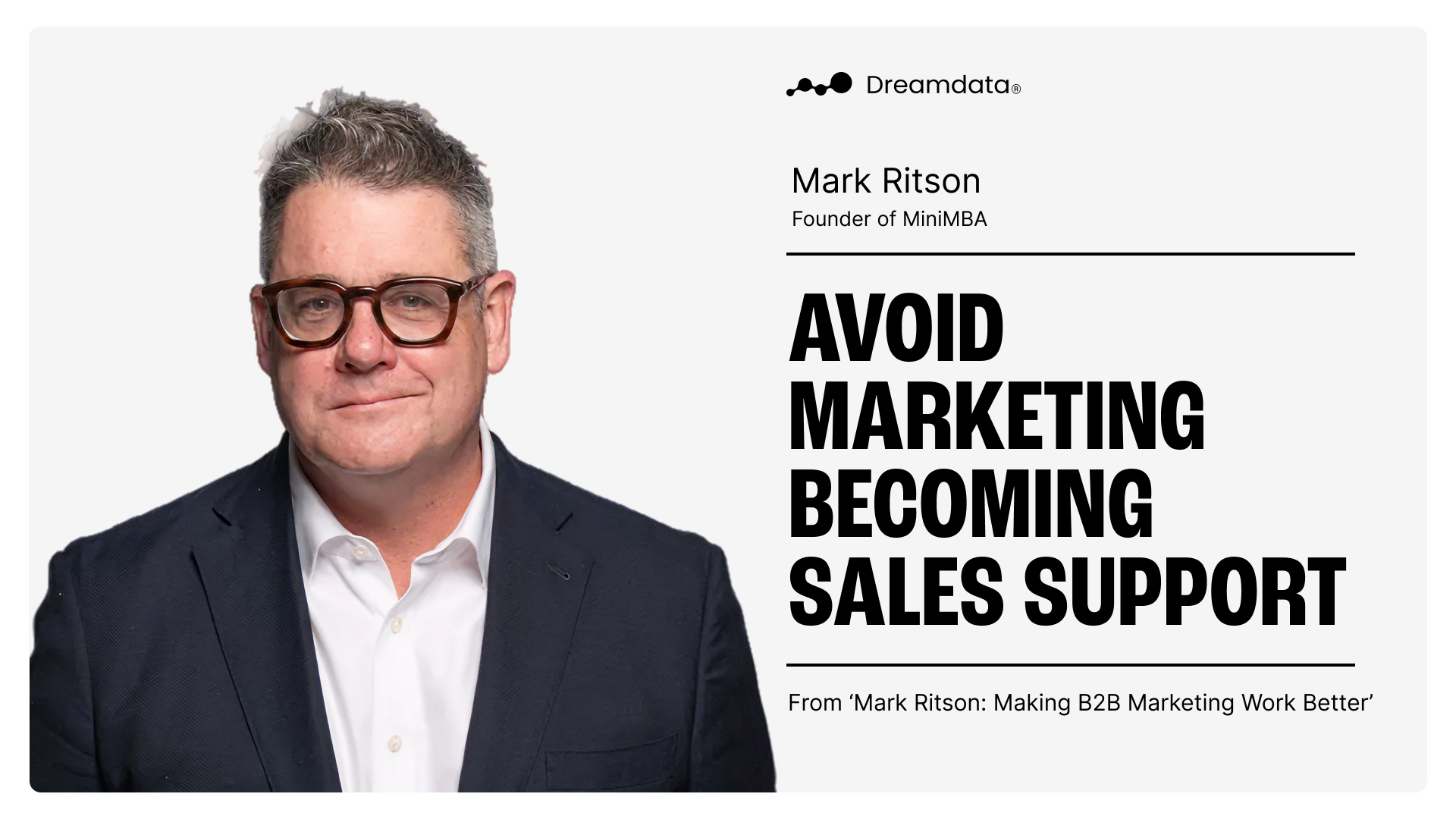
And that counters how many marketing strategies are developed.
Often, sales is brought in after the targeting decisions have already been made. With marketing defining the segments, building the campaigns, and sharing a list of accounts later on.
Mark argues that the stronger approach is the opposite: involve sales much earlier, especially at the segmentation stage. Good marketing, he explains, means marketers are “engaging the sales force at that stage to help build and populate the segmentation.”
The shared process allows both functions to decide on the target together, agree where the account concentrations are, which segments to prioritize, how to approach different markets, and, ultimately, to pressure test what works.
From there, the conversation becomes a joint exercise rather than a briefing.
And the outcome is significant. “[You’re] building a relationship where the sales force actually believes that the marketers will make them more money because of [targeting, positioning, tactical stuff],” he explains.
That’s when marketing starts actively shaping how revenue gets made.
Conclusion
The common thread throughout all of this is that B2B marketing tends to underperform when it’s treated as a short-term function.
When we don’t diagnose the problem before the solution. When strategy gets skipped in favor of execution. When brand building loses budget to performance. When sales and marketing don’t align on targets before going to market.
Getting that order right is what making B2B marketing work better actually looks like in practice. Marketing creates the most leverage when it shapes the decisions that determine whether buyers choose you, long before execution begins.
About the Speaker
Mark Ritson is a marketing consultant, columnist, and founder of MiniMBA, an online training program that has helped 40,000 marketers build foundational marketing skills. He holds a PhD in Marketing and spent 25 years teaching at London Business School, MIT Sloan, and Melbourne Business School.
He is known for cutting through marketing hype and bringing the focus back to strategy and what actually drives commercial results.
