
Why Paid Media Performance Is Getting Harder to Explain
TL;DR: Paid media performance no longer comes from how tightly you control campaigns, but from what you give the platform to learn from. Marketers need to focus on choosing the right signals and introducing budget and channels in a way that reflects how buyers move toward a decision.
Many paid media teams are still tightening targeting, refining keywords, and adjusting bids the way they always have, but the changes paid marketers are introducing to their ads no longer behave the way they used to.
You make a change that should improve performance… and nothing happens. Or worse, results move in the opposite direction. The difficulty is that it’s not always clear what’s actually driving performance anymore.
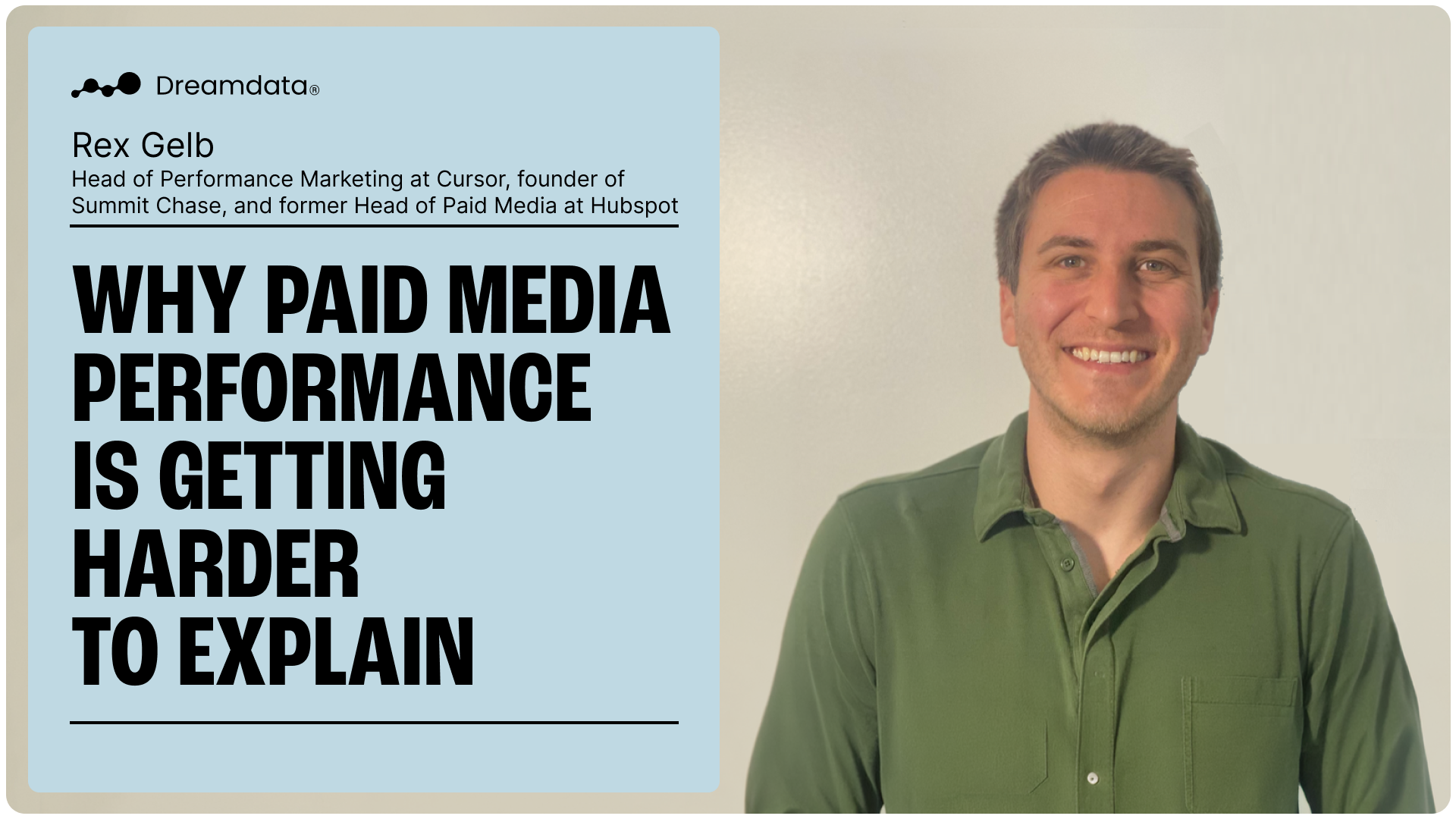
In a recent episode of the Attributed podcast, Rex Gelb, Head of Performance Marketing at Cursor, founder of Summit Chase, and former Head of Paid Media at Hubspot, explains why paid media has become harder to read and what actually drives results now that more of the execution sits with the platforms.
You can also listen to the full conversation with Rex here.
The Leverage Points Have Shifted, Not Disappeared
Paid media rewarded precision for years. The tighter you could define your audience, the more control you had over keywords, bids, and segmentation. And the more control you had, the better your results tended to be.
It was exactly what ad platforms were designed to reward. And teams got very good at it.
More recently, that same playbook feels less dependable. Campaigns don’t behave predictably and changes take longer to validate, making results move in ways that are harder to explain.
As Rex describes it, the trend is clear: “more of the controls that used to be in the hands of advertisers are going over to machines.” Bidding, targeting, and optimization are increasingly handled by the platforms themselves, with the role of the marketer shifting toward strategy and making sense of how everything fits together.
You can see this in what’s actually working. Tactics that used to feel like shortcuts (or even mistakes) are now outperforming more controlled setups.
You can see it on Meta. Careful audience construction has, in many cases, been replaced by the opposite approach: running with minimal targeting and letting the algorithm find the audience on its own. As Rex explains, “best practice on Meta is effectively to have no audience now and let the algorithm rip.”
LinkedIn is a notable exception. Manual bidding and audience refinement still matter there, largely because the platform sees less frequent and slower feedback signals to optimize against. But the broader direction is clear.
Control is still there, but it now sits in a different part of the system.
Performance Starts With Your Inputs
Once the execution moves into the platform, the obvious next question is: where does performance actually come from?
The platform handles more of the mechanics, so performance depends less on how tightly you manage campaign settings and more on what you give the system to work with. “So much of it is built into the platforms now,” Rex explains, including “how you set your bids, how you set your audiences, how you optimize.”
What the platforms need from marketers is direction. In B2B, that means getting closer to pipeline rather than simply generating more activity.
Choose a Signal That Reflects Pipeline
The most important input is the signal you ask the platform to optimize toward.
Every campaign is trained on a definition of success, whether that’s a lead, a booked meeting, or something further down the funnel. But the platform doesn’t know which of those actually matters to your business.
As Rex explains, you need to “find something that correlates… that’s high up in the funnel.” The signal you choose determines what the algorithm gets good at producing.
If the signal is shallow, the system gets very good at driving activity that looks good in-platform but doesn’t translate to pipeline. If the signal is closer to actual buying behavior (even if it’s slower or noisier), the optimization starts to align with how the business actually grows.
Feed Real Outcomes Back Into the Platform
Rex points out that many teams aren’t pushing offline conversion data (things like SQLs or opportunities) back into platforms, even though it’s relatively straightforward to set up.
On Meta, especially when running broad targeting, a couple of things tend to matter more: creative that signals B2B intent clearly and feeding back downstream conversion data so the system can learn.
When the platform is running the execution, it relies on that feedback to improve. Without it, you’re asking the system to optimize without ever showing it what “good” actually looks like.
Creative Becomes Part of the Targeting
As targeting becomes broader, creative starts doing more of the sorting.
With tighter audience setup, the platform handled most of that work. You defined who should see the ad and the system delivered it accordingly.
The ad itself plays a bigger role in determining who engages. The message, the angle, and the framing all act as signals that influence who engages and who scrolls past.
Rex points to creative and conversion tracking as two of the biggest levers left to marketers, now that audience targeting is largely handled by the platforms. Creative needs to make it obvious, within a few seconds, who it’s for.
You Have to Earn the Right to Scale
As execution becomes more automated, the decisions that actually matter (which channels, signals, and sequences you use) still sit with the marketer.
The system will optimize efficiently toward whatever signal you give it. But efficient execution of the wrong setup still produces the wrong outcome.
That’s why Rex’s approach is deliberately structured around learning before scale.
Start with one channel, let it run long enough to understand how it behaves, then expand to another. Each step has to earn the next because, as Rex puts it, starting two channels simultaneously means “you’re just paying for the same learnings twice.”
And budget works the same way.
Rather than allocating the full budget upfront, spend increases incrementally. A campaign earns additional investment once the signal begins to hold up.
In B2B, with longer sales cycles, it can take weeks before anything stabilizes. Our 2026 LinkedIn Benchmarks Report found that buying journeys often span an average of 272 days and 88 touchpoints, which makes meaningful signals slow to materialize.
Rex points out that at lower budgets, it’s not unusual to wait six to eight weeks before you have enough data to judge something properly. Scaling before you’ve validated the signal means you’re asking the algorithm to learn from noise.
Start narrower, let the system learn from a clean signal, and then expand once there’s something that holds up.
Conclusion
Paid media has become less transparent.
The platforms are doing more of the execution, but they’re doing it based on whatever signals and structure you give them. That means the quality of your inputs and the timing of your decisions matter more than the setup inside any single campaign.
Choose signals that reflect real buying behavior. Feed outcomes back into the platform so it can learn. Introduce channels and budget in stages, rather than all at once, so you’re not scaling something you don’t fully understand.
Over time, that’s what determines whether your campaigns drive activity or actual pipeline.
About the Speaker
Rex Gelb is the Head of Performance Marketing at Cursor, founder of Summit Chase, and former Head of Paid Media at Hubspot, where he spent over a decade scaling paid acquisition across global markets. He has managed hundreds of millions in ad spend across platforms like Google, Meta, and LinkedIn, and is known for his focus on aligning paid media with real business outcomes.
