
Why Strong Brand Shortens the B2B Sales Cycle
TL;DR: By the time a buyer enters your pipeline, they’ve already decided who they’re buying from. Most vendors never get considered in the first place, because the shortlist was built earlier through repeated brand exposure and positioning. The problem is that this influence rarely shows up in performance data, so it gets deprioritized.
Watch what happens when a buyer agrees to a demo.
They’ve already seen a handful of companies in their feed, maybe checked out a couple of websites. By the time they reach out, one option already feels like the default. The rest of the process is there to validate that decision.
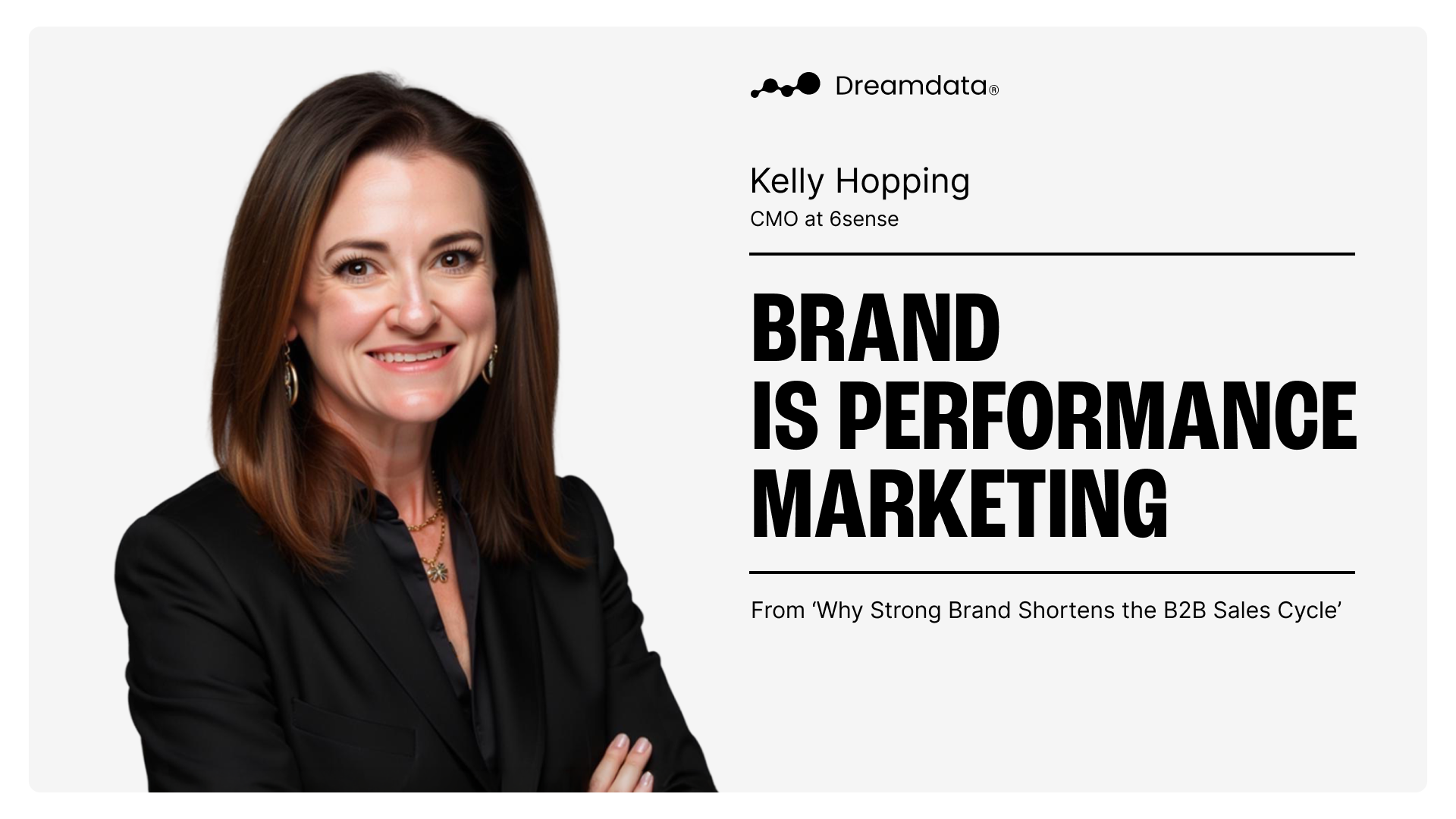
In a recent episode of the Attributed podcast, we spoke with Kelly Hopping, CMO at 6sense, about why most vendors never make it onto the shortlist and how marketing shapes outcomes long before a deal exists.
Keep reading for Kelly’s take on what she calls “performance branding” and why the exposure that gets you on the shortlist rarely shows up in performance data. You can also listen to the full conversation here.
Buyers Aren’t Evaluating Vendors in the Sales Process
By the time a buyer agrees to a demo, they’ve already decided who they’re buying from.
When buyers enter a sales process, they’re not arriving to “objectively evaluate two [vendors]”, Kelly argues. “They’re coming in thinking ‘I’m probably going to get X, but for the purpose of my procurement department, I’m going to entertain a couple of others so that I get the best deal’.”
The evaluation is a formality.
The decision was made earlier.
It was built on what they’ve seen in the market, the peers they’ve talked to, and the companies that consistently show up in their category. Kelly points to research from 6sense showing that “95% of people come into the conversation already with a shortlist.” (That aligns with Dreamdata’s own findings that 81% of the buyer journey happens before the sales pipeline, long before any formal evaluation begins.)
Which means the sales cycle, the part of the journey many B2B marketers work hardest to influence, is mostly processing a decision that already happened somewhere else.
And it’s the “somewhere else” that decides the outcome.
It’s the months of brand exposure before a buying window opens. The same company showing up in your feed, at events, and in conversations, until it stops feeling new and starts feeling like the default. None of that shows up in a CRM or gets attributed to a specific campaign.
So it gets deprioritized.
You Have to be Known for the Right Thing
Being known isn’t enough. You have to be known for the right thing.
“We can drive pipe all day,” Kelly explains. “But if companies aren’t in the market for this category or this position or this role that they think we’re playing, then they’re not gonna even entertain the conversation.”
Before a buying window opens, they’ve already defined the problem they’re trying to solve and grouped vendors accordingly. Each company sits in a category in the buyer’s mind. If you’re not identified, you don’t get evaluated.
Two companies can target the same accounts with similar campaigns and see completely different outcomes. One gets meetings, the other gets ignored.
Kelly describes the challenge: a company can have strong brand recognition in one category and still lose consideration in another because buyers have already decided what the brand stands for. Repositioning that perception is “a hard lift for a sales guy to get around.” It has to happen before the conversation starts.
When brand has done the work of getting a buyer to understand what you do and why it’s relevant to their problem, the sales cycle runs differently. It means that sales isn’t establishing credibility from zero. They don’t have to explain the category or justify why the company is in the conversation.
They’re closing a deal that the buyer already wants to make.
It’s something that Kelly refers to as “air cover”. When marketing has built enough presence in the right places, sales reaches the buyer in a context where they’re already familiar with you. “They get a brand that gives them air cover when they reach out to prospects.”
Less time is spent justifying why you’re in the deal. Instead, more time is spent deciding whether to move forward.
The problem is that these interactions don’t show up clearly in how many teams measure performance.
Performance Branding Connects the Work That Gets Ignored
Many B2B marketing teams still run on first and last touch attribution. The first interaction that brought a buyer in and the final one that converted them. Everything in between (the touches that build familiarity and move a buyer from vague awareness to active consideration) disappears from the report.
And what disappears from the report disappears from the budget conversation.
Kelly’s argument is that brand exposure shapes pipeline long before it shows up in your CRM. And making it visible and measurable starts with questioning what “influence” actually looks like before a buyer converts.
Take display ads. Typically bought by performance marketers and measured on clicks. But B2B buyers, particularly senior ones, don’t click display ads (too close to home, surely). They see them, open a new tab and type the URL in directly. If you’re only tracking clicks, that influence is invisible.
In Kelly’s experience, you need to “connect view-through of the ads to: did that person, within 30 minutes of seeing an ad, go to our website?” In this case, the click never happened, but influence did.
Webinars tell the same story. Content that looks like underperforming mid-funnel activity in last-touch reporting can turn out to be early-stage buying signals. A touchpoint that shapes decisions months before a demo request lands. “We couldn’t see it,” Kelly says, “because it wasn’t the first touch or the last touch, it was somewhere in between.”
And this is what Kelly means by “performance branding”: not treating brand and demand generation as separate efforts, but connecting the interactions that shape perception to the outcomes that show up as pipeline. “Brand doesn’t have to be this thing that costs money and we can’t prove,” she explains, “while digital marketing and campaigns and demand gen sit down here running the pipe. They have to connect.”
Connecting them means building visibility into the full sequence of interactions that precede a conversion, not just the final one.
“That drove me to multi-touch attribution,” Kelly says. “I need to be able to see every touchpoint that a customer’s engaging in. Because it’s a long journey sometimes.”
Conclusion
Brand exposure is what determines who gets considered. Because the shortlist is built on familiarity and clarity, long before a buying window opens.
By the time a buyer enters your pipeline, that filter has already been applied, and without that familiarity, pipeline activity fights an uphill battle. With it, sales can close deals that were already leaning in your direction.
The practical implication is to connect brand and performance. To stop optimizing only for the moment a buyer raises their hand and start understanding what made them want to raise it in the first place.
About the Speaker
Kelly Hopping is the Chief Marketing Officer at 6sense, where she leads global marketing strategy, brand, and go-to-market execution. She has spent over 20 years leading marketing across Fortune 500 companies and high-growth B2B startups, driving performance branding and market differentiation.
