
The Launch Day Lie: Why B2B Product Launches Should Be Campaigns
TL;DR: Treating product launches like single events leads to a lot of activity but little impact. Instead of announcing every feature, teams should prioritize what deserves a launch, reinforce the story through campaign-style messaging, and measure whether it actually influenced adoption or revenue.
Many B2B companies treat product launches like events.
Marketing builds the assets, sales gets enablement, and teams coordinate blog posts, emails, LinkedIn announcements, and live demos to make sure everything goes smoothly on launch day.
But according to Jason Oakley, Founder of Productive PMM and former founding product marketer at Klue and Chili Piper, the biggest mistake many companies make is treating launches like events instead of sustained marketing efforts.
In a recent episode of the Attributed podcast, Jason explains why so many launches struggle to create real impact. He shares how companies can prioritize which features actually deserve a launch and why treating launch day as the starting point of a campaign (rather than the finish line) is a stronger way forward.
Keep reading for a breakdown of how B2B companies can rethink their launch strategy or listen to the full conversation with Jason here.
The Launch Day Treadmill
B2B product launches tend to follow a familiar pattern.
There’s a short window (often a day or maybe a week) where everything goes live: the blog post is published, a launch email is sent, LinkedIn posts are scheduled, and internally sales gets a new deck or enablement doc.
Then the company moves on.
Jason sees this pattern often when working with product marketing teams. In many organizations, launches end up becoming checklist exercises. The focus shifts to making sure all of the moving pieces go live, rather than what happens after the announcement.
“Not many launches have clear metrics or KPIs associated with them,” he explains. Without clear goals, launch success becomes something much simpler: “If the launch goes well, it’s like… did everything get done?”
The problem is that this approach makes it almost impossible to know whether a launch actually worked.
Teams can spend weeks or even months preparing for a launch, but once the announcement is out, the effort stops. There’s little follow-up or reinforcement, and rarely a clear plan for how the launch will drive adoption over time.
So the same pattern repeats – materials ship, boxes get ticked, the team moves on to the next release. When launches are treated as one-day events, the result is predictable: a lot of activity, but very little learning.
Not Every Feature Deserves a Launch
Once you step back from the launch-day checklist, another problem becomes obvious.
Many companies try to launch everything. They follow the same process (blog, email, LinkedIn post, sales enablement), but the market doesn’t experience these launches the way internal teams do.
Buyers have limited attention. Jason points out that when every update is treated like a major announcement, it becomes harder for the important launches to stand out: “There’s only so much attention that the market has. If you’re constantly just shouting about new this, new that… when you do have something that you actually want to move the needle on revenue, they’re less attentive.”
This is why many of the product marketers he works with eventually move toward tiering their launches.

Separate major launches from minor releases
Not every release deserves the same level of effort. Some launches are meant to drive revenue or differentiation. Others exist because customers asked for them, or because the product needed them.
Treating all of these the same creates noise, both internally, where teams spread their effort thin, and in the market, where every announcement starts to look the same.
Instead, stronger launch programs start by doing fewer launches overall.
In practice, that often means bundling smaller releases together instead of announcing every feature individually. Smaller releases can be bundled together or communicated more quietly, while the launches that truly matter get the time, attention, and marketing investment they deserve.
This shift alone changes the role of the launch. Instead of being a routine announcement, a launch becomes something rarer and therefore easier for buyers to actually notice.
The Launch is Only the Beginning
Instead of treating launch day as the finish line, treat it as the starting point.
The announcement is only the beginning. A strong launch program continues afterwards, when the message gets repeated, expanded, and reinforced across different formats and touchpoints.
Jason describes this shift as thinking of launches less like announcements and more like campaigns. As he puts it, “a launch plan is more than just launch day … there’s sequences of events associated with that launch.”
This might mean introducing new use cases over time, sharing informational talking-head content, or showing how different teams apply the feature in practice. Each piece reinforces the same core story instead of introducing something entirely new.
Internally, this can feel repetitive.
But buyers rarely absorb a message the first time they see it. Most are seeing hundreds of competing messages every week.
And that’s why repetition becomes an integral part of the strategy. Instead of constantly introducing new messages, Jason suggests reinforcing the same one over time: “within a three month period we’re going to hit them with the same message many times.”
Rather than six separate feature announcements in three months, the market then hears one clear story repeated and reinforced.
Another benefit of this campaign mindset is that it shifts attention away from constantly promoting the next new feature. As Jason points out, companies often overlook the capabilities customers already value most, even though those are often the features that already drive real adoption. “You have stuff on the shelf that people love you for today … and we don’t put enough effort into marketing those things.”
Campaign-style launches create space to keep reinforcing those proven strengths instead of always chasing the next announcement.
Over time, that consistency gives the launch a better chance of actually landing with buyers. And once launches behave like campaigns, they start becoming sustained marketing efforts that drive real adoption.
Make Launches Measurable (And Learn From Them)
If launches are meant to drive adoption, revenue, or differentiation, they should be measured that way too.
Launch success is often still defined by whether everything shipped on time. The checklist is completed and the team is ready to move on.
Jason argues that the first step is simply defining what success actually looks like before the launch happens. “If you set that goal, then you can work back from it,” he explains.
After that, everything else becomes easier to structure.
1. Define the metric that determines success
Different launches should drive different outcomes. And the goal determines the strategy.
Goals shouldn’t exist in a vacuum, Jason explains. They should be agreed on with leadership and tied to real business outcomes like revenue or feature attachment. “If your CMO [says] ‘this launch is happening and we’re expecting this amount of revenue or this rate attachment on that feature,’ then the purpose of the launch is to drive that.”
Without alignment, launches risk becoming activity rather than strategy.
2. Match the launch effort to the goal
Once the goal is clear, the launch effort should follow.
A revenue-driving launch might justify months of messaging, sales enablement, and campaign support. Whereas a smaller release might only require a lightweight announcement.
“The channels, content, and people involved should change depending on what type of product you’re launching,” Jason emphasizes.
This reinforces the earlier idea of launch tiers: not every release deserves the same level of effort.
3. Run launch lookbacks
One of the most overlooked steps in launch programs is the post-launch review.
Teams spend weeks preparing launches but rarely step back to analyze what actually happened afterward. Jason sees this as a missed opportunity for learning.
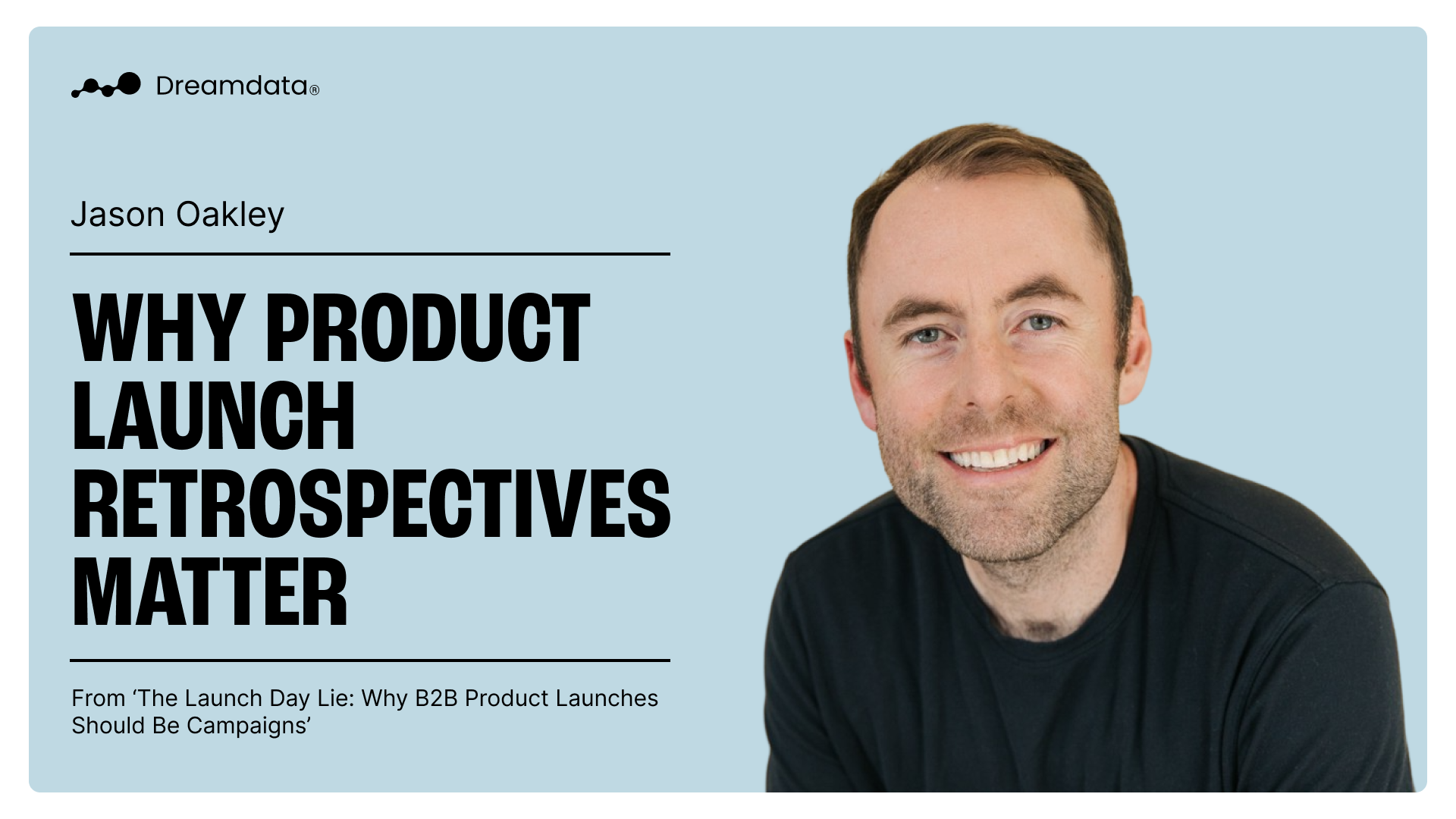
Lookbacks help teams understand:
Did the launch influence revenue or adoption?
Did sales actually use the enablement materials?
Which channels or content drove engagement?
More importantly, they create a feedback loop that improves the next launch.
Conclusion
Buyers don’t experience products in moments. They understand them through repeated exposure and clear, sustained messaging over time.
But a lot of B2B launches are designed around a single moment: launch day.
When every feature gets the same announcement treatment, launches blur together and attention fades quickly. Product marketing teams that see real impact take a different approach. They prioritize what deserves a launch, reinforce the story over time, and measure whether the message actually lands.
That’s when launches start behaving very differently.
Instead of announcements, they become campaigns that shape how buyers understand the product long after launch day is over.
About the Speaker
Jason Oakley is the founder of Productive PMM, where he helps founding and solo product marketers build high-impact product marketing programs through practical frameworks, coaching, and templates.
He previously served as the first product marketer at Klue and Chili Piper, where he built product marketing functions from the ground up and led initiatives for positioning and go-to-market strategy.
