
Why B2B Buyers Choose Safe Decisions Over Better Ones
TL;DR: B2B buying decisions carry personal and political risk that rarely shows up in formal buying processes. The most effective B2B marketing helps buyers feel confident choosing (and standing behind) a decision long after the deal is done.
B2B buyers usually need more help defending a decision than making one.
We compare vendors, highlight advantages, and prove value, expecting decisions to follow. But anyone who’s worked on a long B2B deal knows the real friction shows up somewhere else.
What truly slows deals down is hesitation and internal scrutiny. The quiet question buyers don’t voice in meetings but carry with them anyway: what happens if it goes wrong?
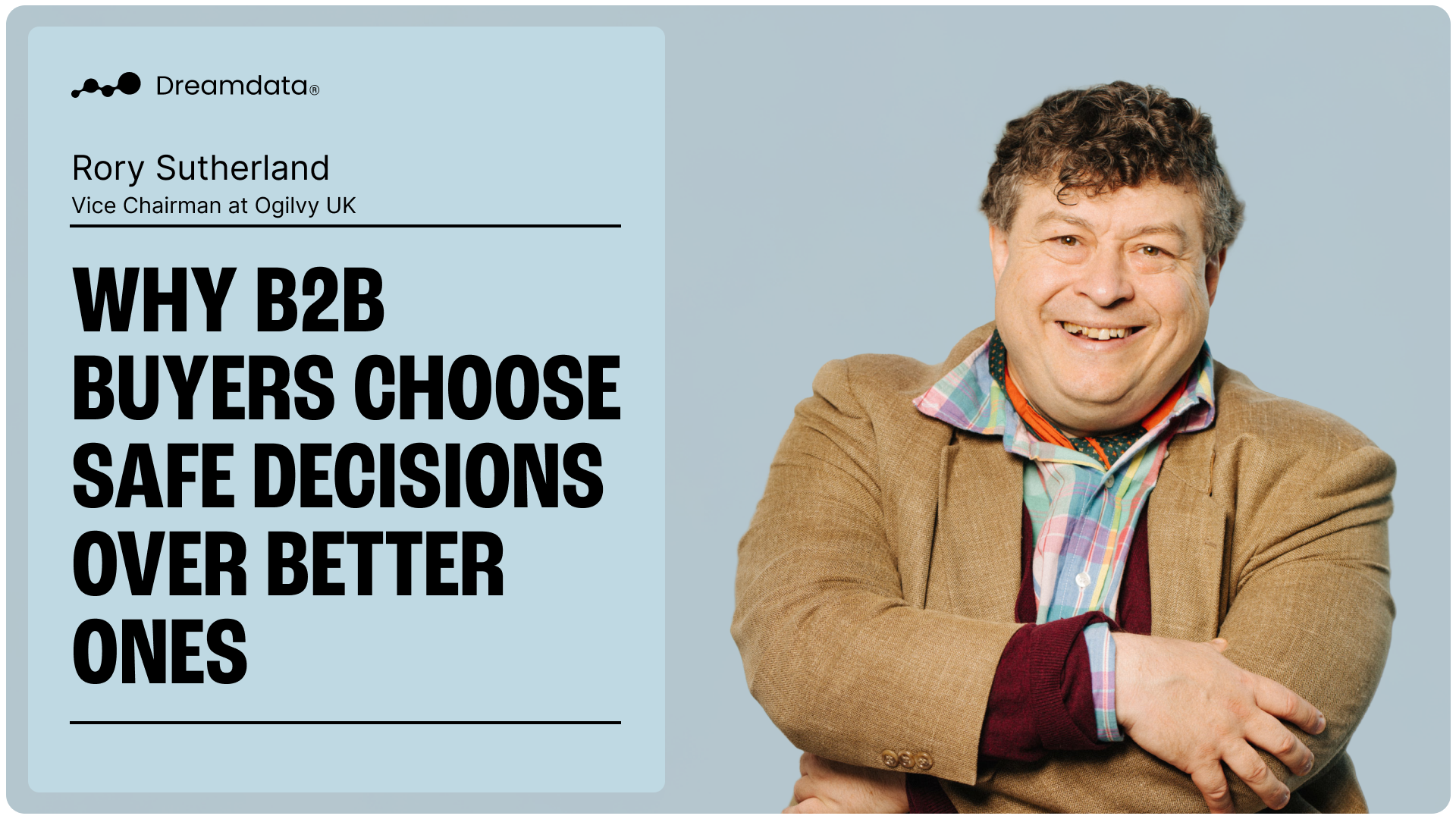
In a recent episode of the Attributed podcast, Rory Sutherland, Vice Chairman at Ogilvy UK, put words to a familiar dynamic in B2B buying. Decisions carry personal exposure. They involve concern about blame and a pressure to make choices that will hold up internally over time.
Keep reading for Rory’s perspective on “irrational” B2B decisions, or listen to the full conversation here.
B2B Buyers Are Managing Fear, Not Upside
B2B buyers like to describe their decisions as rational optimization.
Best vendor. Best ROI. Best decision for business.
But that story doesn’t hold water once you look at what’s actually at risk for the people making the call.

As Rory puts it, “we all pretend we’re trying to make the best decision for our employer. What we’re actually doing unconsciously, emotionally, is trying to minimize downsides, risk, and even more important, blame.”
That asymmetry matters.
In B2B, the reward for a good decision is usually modest – a nod of approval, maybe a bonus. The penalty for getting it wrong can be career-limiting – loss of budget, credibility, your job.
This is why Rory argues that B2B decision-making is often more emotional than B2C, not less. The emotion, however, isn’t excitement or desire, it’s fear. Fear of scrutiny, fear of being exposed, fear of being the person whose name is attached to a decision that ultimately didn’t work.
Once you see that, familiar B2B behavior makes sense.
Committees don’t exist because they make better decisions, they exist to spread responsibility. Safe vendors win not because they’re always better, but because they’re defensible.
“No one ever got fired for buying IBM” wasn’t an advertising line. It was a behavioral truth of how risk actually works inside organizations.
In general, buyers aren’t asking themselves, “What’s the best option?” Their subconscious is asking something else entirely: what’s the worst that could happen if this goes wrong?
And that question almost never shows up in meetings, requests for proposal, or dashboards. Rory describes it as implicit, felt intuitively, but rarely discussed out loud.
If buyers are primarily managing fear and blame, then winning the deal is about making a decision feel safe. Safe to choose, safe to defend, safe to stand behind later.
Why Persuasion-First B2B Marketing Falls Short
Most persuasion-led marketing is built to win comparisons. It assumes buyers are weighing options side by side and asking, “why should I choose you?” So we focus on proof points, differentiation, and arguments that show why we’re the stronger choice.
But that’s rarely the hardest part of the decision.
It’s what happens after the choice is made, how it will be explained internally and held up if results are questioned months later.
Rory’s framing is direct: “A lot of marketing isn’t desire creation, it’s reassurance.” The issue isn’t that buyers don’t care about outcomes (they definitely do), it’s that outcomes aren’t what put buyers personally at risk, failure is.
Persuasion alone often underperforms in B2B because it tries to move buyers forward without addressing the risk attached to moving forward as the person making the decision.

Rory describes noticing this dynamic – the gap between public discussion and private risk – when presenting work to senior marketers. On the surface, the discussion was about effectiveness. Underneath, something else was going on. As he puts it, “50% of the person’s brain is going ‘how the hell am I going to sell this to my boss?’”
That internal conversation matters more than most messaging assumes.
And you see the same pattern in how buyers react to unfamiliar vendors. Rory points out that in many boardroom discussions, the majority may never have heard of you and your brand before. When that happens, they become cautious because unfamiliarity increases risk.
That’s also why well-known brands carry such disproportionate weight in B2B. They’re not always better, but they come with the benefit of the doubt. If something goes wrong, responsibility can be shared or externalized and the personal risk feels lower.
This is the gap persuasion-first marketing leaves open.
It can explain why a product is good.
It rarely makes the decision safe.
That hesitation is where most B2B decisions are actually worked through.
Start With What Nearly Stopped the Buyer
If the goal of B2B marketing is to reduce the risk of saying yes, the work has to start in a different place.
Rory’s most practical suggestion isn’t a framework or messaging model, but a question he encourages marketers to ask after a deal is done:
“What nearly stopped you from buying this?”
That question points directly at risk. Not the value buyers justify afterward, but the hesitation they had to work through before committing.

By the time someone buys, Rory explains, they’ve already negotiated an internal risk. That risk doesn’t disappear once the contract is signed. It shows up later when a decision is reviewed, questioned, or held up against results and expectations. Understanding it gives marketers a clearer signal of where reassurance actually matters in the journey rather than why the buyer converted.
In practice, those answers often have little to do with the features you offer or the performance of your product.
Sometimes it’s familiarity.
Or how the decision will look internally.
Or whether choosing this option creates more questions than it resolves.
For B2B marketers, this reframes what insight looks like, asking why buyers almost walked away rather than why they converted. It’s where marketing can reduce exposure and make a decision easier to stand behind later.
Conclusion
If B2B buying is a risk-management exercise, then a lot of familiar outcomes make more sense.
Persuasion alone rarely carries a deal. What matters is whether a decision will feel safe when it’s questioned later.
That’s the job Rory argues for B2B marketers: reducing the personal and political risk of saying yes and helping buyers stand behind their decisions long after they’ve made them.
About the Speaker
Rory Sutherland is Vice Chairman at Ogilvy UK, where he has spent decades working at the intersection of creativity, behavioral science, and strategy. He co-founded Ogilvy’s behavioral science practice and is known for applying insights from psychology and economics to explain how real decisions get made inside organizations. Rory is also the author of Alchemy, which explores why irrational insights often outperform conventional logic in decision-making.
