The Better AI Gets, the More the Foundation Matters

We’re only at the beginning of understanding what AI can do for business.
Within B2B marketing, I’m convinced there's an enormous opportunity to use AI to make marketers better at what they do. We’re already seeing what that looks like in B2B go-to-market. Questions that used to take a day, and a data team, now take seconds. Repetitive tasks are being automated.
But as AI gets more capable, what you feed it matters more than ever. Building an agent has become incredibly easy, but giving that agent the context to understand your business, and knowing you can trust what comes back, is much harder.
That’s what we’ve set out to solve with Dreamdata AI.
We believe the value of AI in B2B marketing won’t come from another chat window. It’ll come from giving increasingly capable AI a foundation that actually understands your B2B go-to-market.
AI Doesn’t Care What It Amplifies
Rushing out and using AI just to use AI isn’t the right idea.
Generic AI is smart and incredibly fast. But it’s also confident in ways it shouldn’t be. Give it good data or bad, an agent can give you a confident answer either way. It won’t pause or flag that the context is missing or that the definitions don’t match across teams. It just answers.
As agents start doing more than answering questions, the consequences of that get bigger. An agent can make ten decisions for you before you’ve even arrived at the office in the morning. Whatever you give it to work with gets carried into those decisions too.
The problem is that a lot of AI still works like a black box. You ask a question, get an answer back, and you’re unsure whether you can trust it or where it even came from.
The Agent is the Interface. The Foundation is the Asset.
As it’s always been in software, the user interface is the easiest part to build. What’s different now is that we have interfaces that are uber-confident and human-like, so we’re more likely to take that answer at face value.
But an AI answer is only as good as the data model it reasons over and the workflow that puts the intelligence to work. Which is why the foundation for all of this matters more now.
Get that layer right and the confident interface becomes a genuine superpower: trusted, consistent answers everywhere, instantly, for everyone on the team, not just the analyst who knew where the bodies were buried.

It's also why I believe every answer should show its work: How was this number built? What data went into it? Can I click into the accounts and touches behind it?
When an answer opens up like that, scrutiny stops being a threat and becomes proof. You let the agent do the labor, but you keep the understanding, so when you’re asked about the analysis, you can answer confidently in the moment.
And I want to be clear on this one: this isn’t a trade-off. The old assumption was that trust costs you speed, that verifying the work meant doing it twice. That's only true if verification is manual.
When verification is built into the foundation, when you can see exactly what an answer was built on, checking a number takes a click instead of a week. You get the efficiency of AI without giving up the trust that comes from being able to check the work.
This is where we've spent years: not on the chat window, but on the account-based data model underneath it. The agents, ours or yours, are how that investment becomes available to you.
Learn more about the data foundation behind Dreamdata AI →
Three Ways In, One Foundation
We don’t believe there will be one AI tool that everyone uses for everything. Different teams already work in different ways, and that will only become more true as AI develops.
So we built Dreamdata AI to meet you where you are.
Whether you work inside Dreamdata with the Analytics Agent, bring Dreamdata into the AI tools you already use through our MCP Server, or run your own agents on our Data Warehouse, you’re starting from the same foundation.
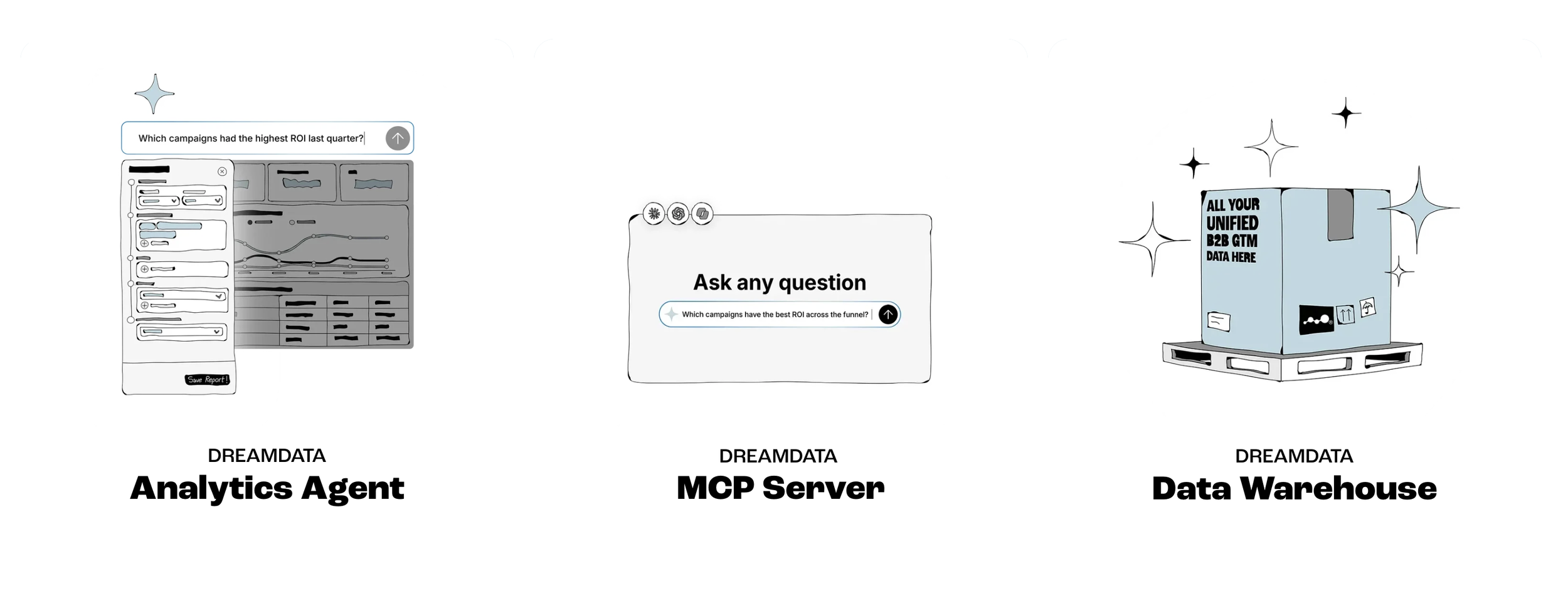
The Analytics Agent.
An agent built directly into Dreamdata for the reporting your team runs on: pipeline reviews, board numbers, channel performance, the reports you need to be right every single time.
Because it works from a data model that understands your business’ context, it knows what a stage means, what's excluded, and how revenue is attributed. The numbers come back reliable and consistent, whoever asks and however often.
When the standard report raises a harder question, you don't switch tools. Ask a follow-up question, and it goes as deep and as ad hoc as you need.
The MCP Server.
If your team already works inside Claude, ChatGPT, or Gemini, you shouldn't have to leave them to get trustworthy answers about your revenue.
With the Dreamdata MCP Server, your preferred AI connects straight to your go-to-market data with the same consistent definitions and calculations behind the Dreamdata Analytics Agent. Your preferred agent stops guessing at your definitions and starts working from your actual data.
You bring the AI. We’ll bring the context it needs to give you answers you can trust and verify.
Your Data Warehouse.
For AI-native teams, the most valuable thing we can hand you is the foundation itself: a clean, connected, complete account-based data model, in your own warehouse, ready for whatever you want to build on it.
Your GTM data, your agents, your rules.
Three doors, one house.
Teams that want plain-language answers, teams that live inside Claude all day, and teams building their own agents on the Data Warehouse are all working from the same trusted foundation. The choice between them depends on your use case, how much flexibility you’d like, and where you prefer to work.
However you work, doing it on Dreamdata’s data model beats doing it without, every time.
Find a full breakdown of all three Dreamdata AI offerings here →
Core Competency Still Wins
There’s a broader belief behind all of this: AI isn’t going to make specialization
less important.
You can already see it happening at the top of the market, where the frontier labs are already specializing, some toward the consumer and some toward enterprise. That’s going to keep happening further down the stack too.
And as agents get better, what you give them to work with becomes the differentiator.
Our core competency has always been the B2B customer journey: collecting it, cleaning it, connecting it, and modeling it. We’ve spent years building the most complete view of that journey, from the first anonymous touch to closed revenue.
That foundation becomes even more useful as AI gives marketers new ways to work with it. It makes the Analytics Agent sharp, makes your preferred agent smarter when using the MCP Server, and makes the Data Warehouse worth building on.
Start Where You Are
There’s no doubt AI is going to keep getting better. Our focus is on what we do with it: how we use it to make Dreamdata better so B2B marketers can be better at what they do.
You don't need an AI transformation project to get value from this.
Ask the Analytics Agent your hardest marketing questions. Connect Claude over the MCP Server. Point your data team at the Data Warehouse.
Whichever one fits what you’re doing, it’s the same play: build on a foundation you actually trust, demand answers you can verify, and keep the thinking for yourself while the agents do the labor. You never have to choose between moving fast and being right.
However AI develops from here, you can count on us to make it trustworthy and to keep building for B2B marketers.