
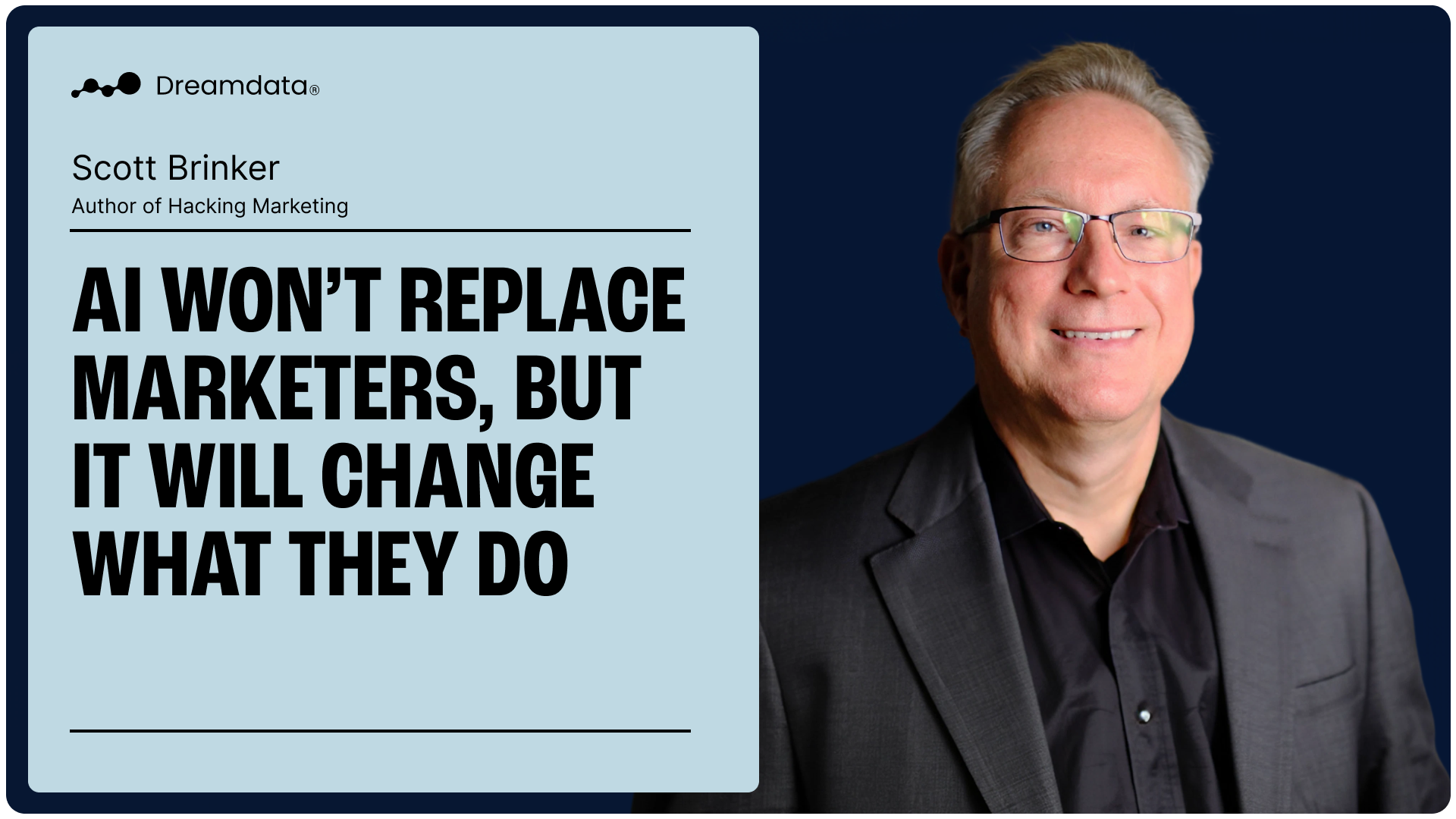
AI Won’t Replace Marketers, But It Will Change What They Do
TL;DR: The more AI can execute, the more B2B marketing depends on the human judgment behind it. Marketers become the counterweight to AI sameness, bringing the differentiation and coherence that technology can’t decide for them.
AI can summarize your ICP research, help your buyers compare potential vendors, write the first draft of your latest blog, and automate the workflows you’ve spent hours on.
So where does that leave us in B2B marketing?
In a recent episode of the Attributed Podcast, we sat down with Scott Brinker, creator of the Martech Landscape and former VP Platform Ecosystem at HubSpot, to talk about what happens to marketing (and GTM strategies) when AI takes on more of the work.
Scott has spent 15 years watching technology change what marketers can do. He sees a different set of challenges emerging as AI removes more of the limits on what we can research and execute.
Keep reading to learn what Scott thinks B2B marketers should be paying attention to as that shift takes shape.
Marketers Are The Counterweight to AI Sameness
Just because we can produce 100 pieces of content in a few seconds, doesn’t mean we should.
Ask AI for ten campaign concepts, twenty LinkedIn posts, a few positioning ideas, or a first draft of your next landing page and you’ll probably get something passable back.
But your competitors are doing the same thing.
“The mission of marketing is to differentiate [from] whatever anybody else is doing or what other people are saying,” Scott says. “You don’t want to converge to doing that exact same thing, you want to find some way to stand out.”
Scott points to Ethan Mollick’s idea of the “jagged frontier” of AI. Models excel in some areas and struggle in others. Disciplines like coding give AI clearer constraints to work within, you can test whether the code actually works. Marketing asks AI to do something different: to stand out.
Generative AI is good at convergence and synthesis. Give similar models similar prompts, trained on similar bodies of knowledge, and they tend to produce similar answers. Your copy can be polished and your strategy can sound reasonable.
And so can everyone else’s.
Scott describes marketers as “one of the best counterweights to the AI side of things.” The more a company can produce, the easier it becomes to lose the red thread. Buyers get surrounded by content without getting a clearer idea of why they should care about you.
Your job is to create that coherence. “Let’s synthesize. Let’s create the coherence of ‘what is this brand? What is this product? What do we stand for? How do we do it?’” It requires judgment and taste.
You need to know which ideas truly fit your brand, which messages differentiate you from your competitors, which campaigns are strong enough to put more money behind, and which content gives your buyers something useful rather than adding another piece to the pile.
That makes your specialist expertise more valuable as AI takes on more execution. AI can give you more options, but you still need the judgment to know which ones are worth pursuing.
Buyers Are Closing the Information Gap on Sellers
The same synthesis that creates a differentiation problem for marketers creates an information advantage for B2B buyers.
Buyers have always had access to plenty of information, the struggle was putting it all together. You’d Google the solution you were looking for, open ten different tabs, dig through vendor websites and review sites, and try to work out how all of the options compared.
Or, at some point, you’d set up a demo call and ask the seller directly.
Now, you can ask ChatGPT or Claude to compare vendors, explain the differences, summarize reviews, and answer questions about how a product might fit your unique situation. Buyers can uncover information that B2B companies have traditionally kept gated behind a sales conversation.
Scott uses enterprise pricing as an example of this. Previously, if pricing wasn’t public, buyers had to speak with sales to understand what a product might actually cost. Ask an LLM and within a few minutes, you can have a pretty decent sense of likely pricing and even discounting patterns other customers have discussed.
LLMs have “helped close the information asymmetry between buyers and sellers,” Scott argues. And that imbalance is now “shifting to the buyers in a much more significant way than it ever has before.”
Our 2026 LinkedIn Ads Benchmarks found that 81% of the B2B customer journey happens before the sales pipeline, up from 70% the year before. Your buyers are spending most of their journey researching, comparing, and forming opinions before they ever speak to sales.
Sales Has to Give Buyers a Reason to Trust
When buyers finally do speak with sales, they need something different from the conversation. Something that’s harder to research independently: “I really need to understand the actual process of how we’re working together and develop that trust,” Scott explains.
Buyers can use AI to close the information gap, but they still need people to close the trust gap.
Your buyers are now asking questions about you without asking you. Which means marketing has to influence conversations it may never see. Companies need to make sure “we’re getting the right information out there in those systems because if we don’t get it out there, somebody else is going to get it out there and it may not be the right [information] or the one we want.”
You can’t control the answer ChatGPT gives when someone asks about your product. But you can make sure your pricing, product information, use cases, and proof points are clear enough for both buyers and machines to understand.
Marketers Should Set the Intention
So where does marketing technology stand in all of this? Scott’s suggestion is that AI won’t replace marketers, but it will change what they do.
He draws an important line between using AI to help you do the work and asking it to do the thinking for you.
“There’s a really big difference between leveraging these tools to help us in what we’re driving, what we’re creating, what we’re thinking through,” Scott says, and “outsourcing the thinking and the writing and the building to something that then ultimately [we] don’t understand.”
He’s less excited about marketers generating another hundred pieces of content and more interested in using AI to change how the work gets done.
Your workflows might use AI to remove repetitive steps, connect tools, change how information moves through a process, or create an experience that fits your buyers better. But Scott’s starting point is important: “I have something I actually want to do. I want to see this work this way.” You start with the intention. AI helps you execute it.
That keeps you in control of what AI does, rather than asking it to decide what you should say, create, or think.
Conclusion
Having more ways to create and execute doesn’t solve the harder question of what’s actually worth doing. That’s still a decision that sits with marketers. We decide what makes our brand distinctive, what buyers need from us, and where AI can improve our work.
As AI takes on more of the execution, those decisions carry more weight. Our taste and judgment determine whether all that extra capability produces better marketing or simply more of it.
About the Speaker
Scott Brinker is a martech analyst, author, and the creator of the Martech Landscape, which has tracked the growth of the martech industry for more than a decade. He previously served as VP of Platform Ecosystem at HubSpot, where he built its technology partner program to more than 2000 software partners.
Scott is also the author of Hacking Marketing and writes chiefmartec, where he covers how technology continues to reshape marketing organizations, operations, and the way marketers work.
