
Leslie Venetz: Why Your B2B Outbound is Killing Your Brand
TL;DR: Every outbound message contributes to how B2B buyers perceive your company. Relevant outbound comes from understanding buyer problems well enough to have an informed opinion, then reinforcing that understanding across every marketing and sales interaction.
A lot of B2B outbound has become high-volume and low-value, and buyers can tell.
If your message misses, it leaves an impression with your potential buyer: a little brand damage, a little more reason to ignore your next email or LinkedIn message, or another reminder that your company has nothing new to say. AI hasn’t slowed any of this down. If anything, it’s made it easier to send low-value messages at a much larger scale.
In a recent episode of the Attributed podcast, Leslie Venetz, Founder of The Sales-Led GTM Agency, shared why understanding buyer problems creates more relevant outbound and stronger buying conversations.
Here’s how you change the way buyers experience your brand – it starts with the buyer and building your message around their reality instead of your product.
You can also listen to the full conversation with Leslie here.
The Best Outbound Starts with a Person
“We sell this. Here’s what it does. Here’s why you should care.”
A lot of outbound messaging follows the same logic: company → product → benefit. But for your buyers, it’s the opposite: they start with their own problems.
Product-first messaging often doesn’t work because buyers aren’t evaluating products in isolation. They’re determining whether solving this problem is worth their time and budget, and the internal effort it will take to make a change.
Whether they respond or not, every outbound message you send contributes to your buyers’ impression of your company.
Early in her career, Leslie realized that she wasn’t asking someone to approve budget, she was asking another human to take on risk. Those decisions carry personal and professional consequences.
Leslie explains that buyers are choosing to “expend their social capital to advocate for [a] product or service, to spend their limited budget on this instead of something else, [and] to push it out and onboard it for their team.”
When you stop seeing buyers as job titles and start seeing them as people navigating competing priorities, internal politics, and career pressures, your messaging changes. You stop asking, “How do I personalize this email?” and start asking, “What is this person trying to accomplish? What’s making their job harder right now? What would make this conversation worth their time?”
It’s the difference between writing about your product and writing about someone else’s reality.
Facts Aren’t Personalization
You’ve definitely received an email or LinkedIn DM that starts off with something like “I saw you were the Director of Marketing at Company X”, directly followed by a pitch for a product you’ve never heard of.
AI can help you gather information – it can quickly identify job titles, new funding rounds, promotions, hiring trends, and technology stacks in seconds. But showing someone you know the facts about them is not enough.
As Leslie puts it, there’s “a difference between stating something that’s true and personalization.” Too much outbound repeats information buyers already know about themselves (or worse, simply says “I was looking at your profile” – whatever that means?) without explaining why it matters.
Buyers want evidence that you understand what those signals mean, not proof that you ran a Google search. When every company sends the same research-backed opener, buyers stop seeing it as personalization and instead start associating your brand with generic outreach.
A funding announcement, for example, signals that the people inside a company are likely dealing with new expectations from investors, an updated organizational structure, tighter profit margins, new business priorities, for example. Those are the insights that buyers are more likely to connect on, with the funding round as evidence of change.
Leslie’s argument is to stop narrating what happened and start explaining what it means for them. Instead you should approach people with, “here’s an insight and observation that, based on my expertise selling this solution or service into this market, I believe to be true…”
That connection tells buyers you’ve done your research and you understand what those facts mean.
Specificity Creates Relevance
You understand your buyer by recognizing patterns.
You don’t get there by researching individual buyers for five minutes before sending an email. You get there by spending enough time with a specific type of buyer that the same patterns begin to repeat.
The broader your ideal customer profile, the harder it becomes to make observations that feel genuinely relevant. When your ICP includes everyone from early-stage startups to enterprise organizations, or every sales leader from enablement managers to CROs, the only things you can confidently say are the things that are true of almost everyone.
Broad audiences force broad observations.
And when every buyer receives the same generic observations, relevance disappears. Over time, so does the perception that your company understands the people it’s trying to help.
So, Leslie narrows the audience before she ever writes the message. She uses four firmographic filters (ie. subindustry, revenue band, geography, employee count) and one demographic filter (ie. job title, department, location) to define a group of buyers who are likely navigating similar challenges. The point is to create one thoughtful observation that reflects a shared reality across the entire audience.
The question changes as a result.
Instead of asking, “How do I personalize this message?”, you’re asking:
“Based on the challenges that companies at this growth stage are going through, based on the pressures of a VP of Marketing, what are things that I know are true that I believe my product or service can help solve for?”
That redefines what an ICP actually is: a group of buyers whose problems you understand well enough to have an informed opinion about, rather than a list of companies you’re hoping will buy your product.
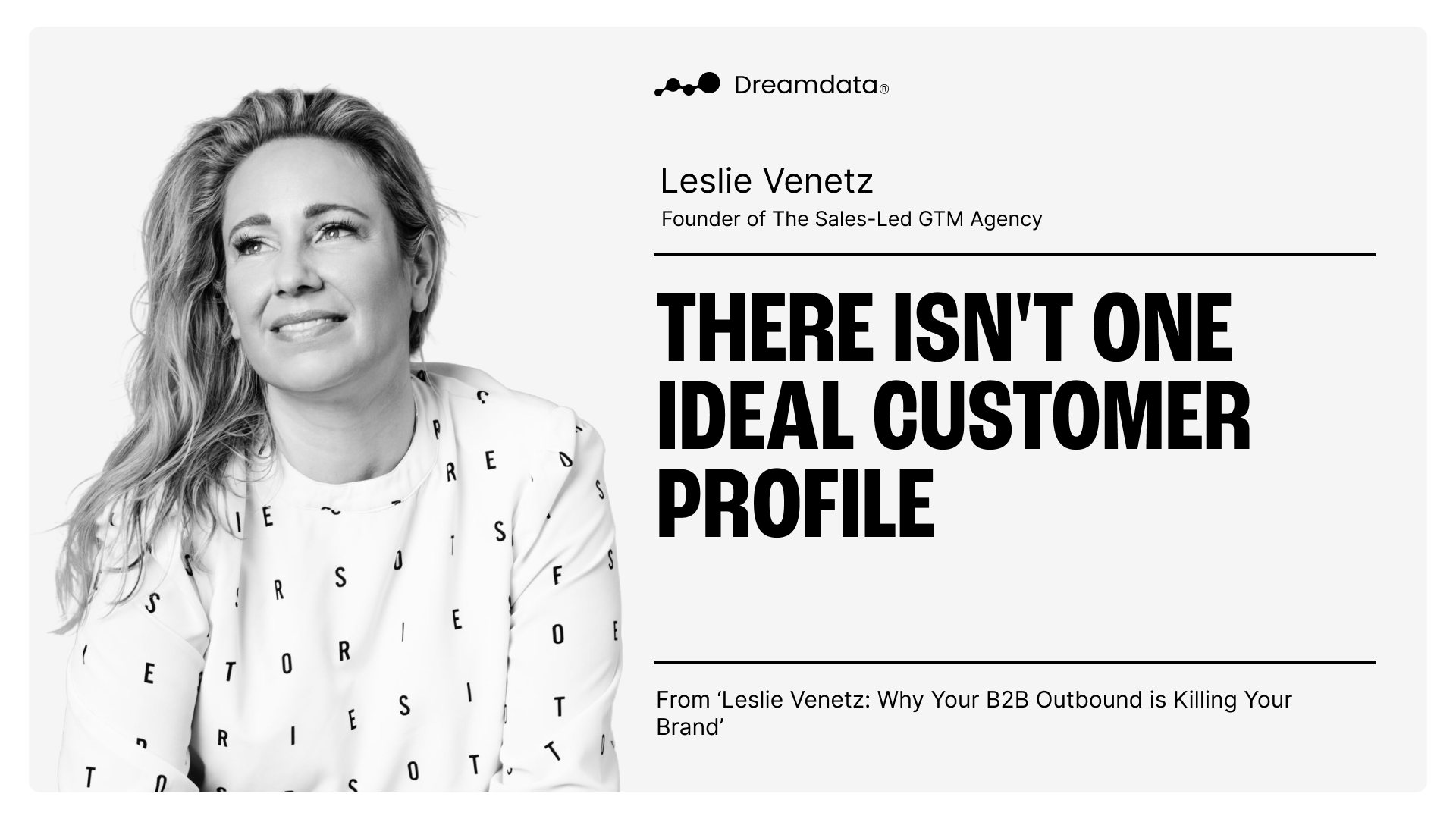
Which is why Leslie argues that there isn’t one ideal customer profile. There are multiple ICPs, each shaped by a different challenge. A company becomes “ideal” because of the specific problem you’re uniquely equipped to solve and that definition evolves as markets, buyer priorities, and your own understanding of buyers change.
Once you understand the pattern, relevance stops coming from the pain points you’ve researched and starts coming from what you’ve experienced in actual conversations.
Trust Develops Across Marketing and Sales
B2B buyers experience your company as one continuous conversation, whether that touchpoint came from marketing or sales. Each team has a different role in the conversation, but buyers expect them to reflect the same understanding of their situation.
As Leslie puts it, “marketing’s job is to create copy that very effectively communicates one-to-many… and sales’ job is to create copy that feels one-to-one.” They’re different conversations, but they should begin from the same place.
Marketing helps buyers recognize a problem. Sales makes it personal.
Neither starts by talking about the product.
Instead, both start by demonstrating an understanding of what buyers are trying to achieve and what’s making that difficult.
Leslie frames it as a broader shift in perspective: “How much of this is seller-centered and company-centered versus centered on the problems [and] outcomes that matter most to [buyers] and customers?” You don’t need to use the same words or channels as sales, but you do need to start from the same understanding of what buyers care about.
That shared understanding becomes increasingly important because B2B buying doesn’t happen through a single interaction.
The average B2B buying journey takes 272 days and spans 88 touchpoints across multiple channels. Buyers don’t evaluate single interactions across emails, social media posts, events, and conversations. They form an opinion over time about whether your company understands the problems they’re trying to solve. “It’s all of those touches that stack together to build enough trust that somebody is willing to engage in a buying conversation with us,” Leslie agrees.
Every interaction either reinforces that understanding or weakens it.
Conclusion
You get another opportunity to recognize patterns and deepen your understanding of your buyers with every conversation and campaign. Those observations become informed opinions about the problems they’re likely trying to solve.
That’s the understanding buyers experience across every interaction they have with your company. It’s what makes marketing and sales feel like one continuous conversation instead of disconnected touchpoints.
AI has made it easier to send more outbound, but earning someone’s attention still comes down to understanding the actual person on the receiving end.
About the Speaker
Leslie Venetz is the Founder of The Sales-Led GTM Agency, corporate sales trainer, and enterprise selling expert with 15 years of experience opening doors to companies like Walmart, ExxonMobil, and JP Morgan. Through her agency, she advises and trains B2B sales teams on outbound strategy, helping them build processes and skills to run GTM motions that actually generate revenue.
