
Using AI to Close the Gap Between Signal and Follow-Up
TL;DR When pipeline falls short, teams often assume they need to generate more demand. In reality, many gaps stem from inconsistent follow-up and missed engagement across active accounts. AI works best as an execution layer, ensuring signals are acted on reliably rather than depending solely on team capacity.
When pipeline targets slip, the instinct is often to look upstream. Was there enough demand? Did we run enough campaigns? Was our reach wide enough?
Most B2B teams already generate meaningful intent signals. Inbound requests arrive, accounts show intent, and engagement builds across multiple channels. The challenge tends to surface in what happens next – how consistently those signals are acted on and how long opportunities stay in focus.
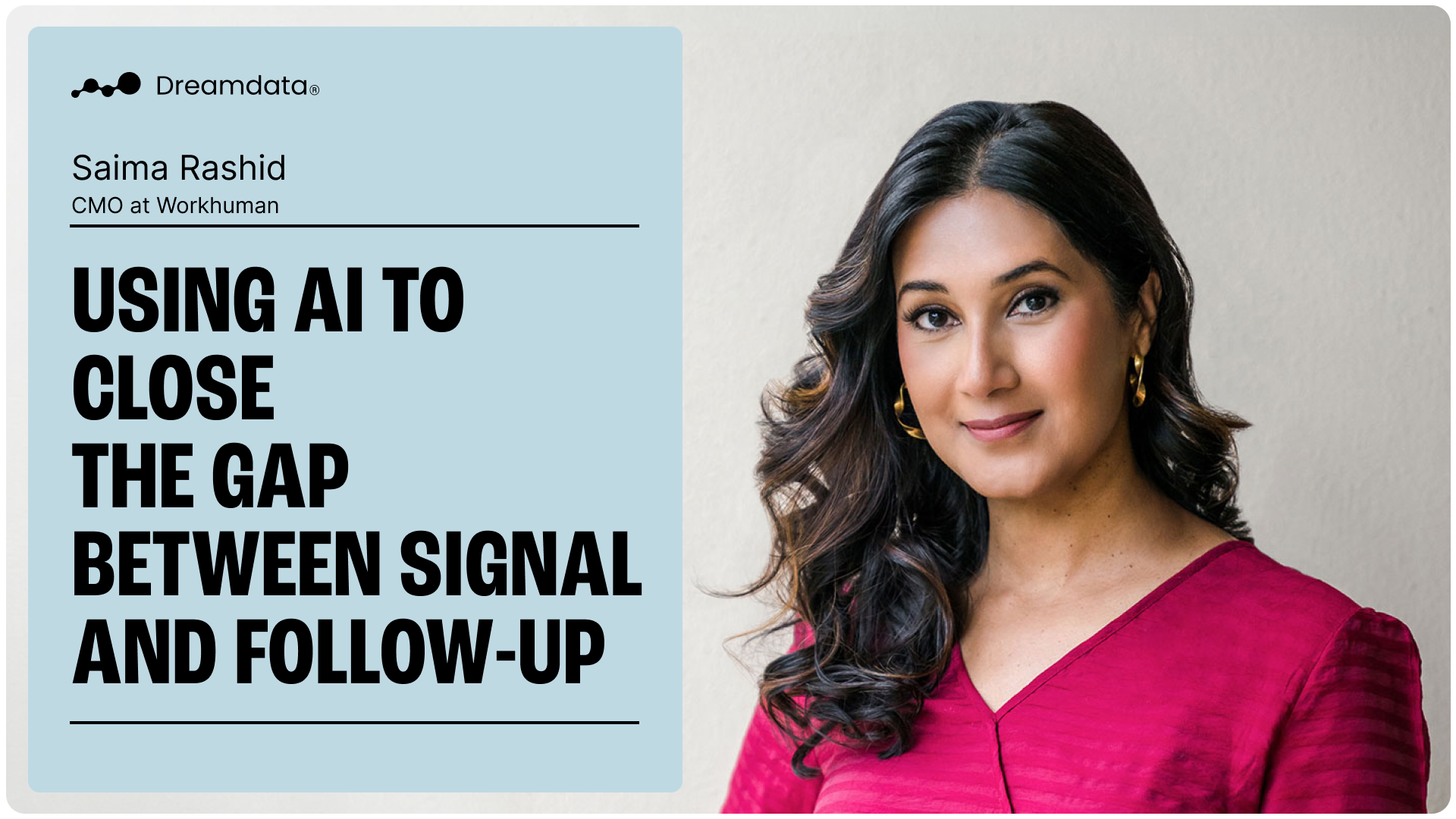
In a recent episode of the Attributed Podcast, we spoke with Saima Rashid, CMO at Workhuman, about how she thinks about implementing AI inside go-to-market workflows. The conversation focused on execution, specifically how tightening follow-ups across the funnel changes pipeline performance.
Her perspective centers on a simple observation: pipeline erosion often happens in the space between identifying a signal and responding to it.
You can also listen to the full conversation here.
Where Does Execution Break Down in B2B Go-To-Market Engines?
Pipeline gaps often get treated as a demand generation issue. But in practice, they more often reflect inconsistent follow-up across active accounts and missed re-engagement opportunities.
If pipeline is the number marketing is accountable to, then what happens between when an intent signal is identified and follow-up is sent deserves more attention than most teams give it.
“We will win or lose as a marketing organization in terms of how we deliver on the pipeline plan,” Saima says. At the same time, she acknowledges what most growth marketers already recognize: there are multiple points of leakage across the funnel.
Demand is generated, but follow-up doesn’t always match the volume or timing of those signals. Inbound requests come in, high-intent accounts surface in dashboards, and engagement data accumulates across channels – yet the time it takes to respond and the depth of the follow-up really vary depending on how busy a team is, and how effectively high-value accounts and buying groups are prioritized.
We can see buyer activity in our tools and dashboards, but turning those signals into consistent action is the harder part. One way to operationalize this is by spotting buyer intent signals and notifying sales in real time. The mechanics aren’t complicated, but they do require structure.
And that’s the gap that AI can realistically close.
When Saima’s team set a six-minute service level agreement (SLA) for inbound follow-up, she was open about the constraint: “Not everyone can hit it, but AI can.” The goal was to make sure a buyer’s raised hand didn’t sit untouched simply because someone was busy.

Speed is only one part of the leakage problem, however, coverage is another.
B2B deals rarely hinge on a single contact. Saima points out, “we know that we don’t sell to a single person in any B2B marketing motion. You’re selling to a buying team of 5 to 20 people.” If outreach focuses on one individual, the account remains partially worked while the broader buying group continues researching and evaluating independently.
The third gap is re-engagement. Closed-lost opportunities, event attendees, and high-intent accounts that didn’t convert the first time were previously active. Without structured follow-up, they fall out of focus.
These are all execution issues.
This is why Saima’s framing matters: “It wasn’t humans versus agents, it was humans plus agents.” AI handled monitoring and structured follow-up, while sales reps focused on conversations, multi-threading, and moving opportunities forward.
Before investing in more top-of-funnel activity, it’s worth examining how reliably existing demand is being worked.
Used this way, AI functions as an execution layer inside go-to-market, ensuring signals lead to action instead of sitting idle.
Start Where Friction is Highest and Risk is Lowest
If pipeline leakage shows up in execution, the practical question then becomes where to strengthen it first.
Saima’s advice is straightforward: begin with structured, repeatable work.
“Structured repeatable tasks are a great place to start,” she says. These are workflows most go-to-market teams already run: weekly reporting, inbound routing, event follow-up, re-engagement sequences. They’re defined and predictable; what varies is consistency.
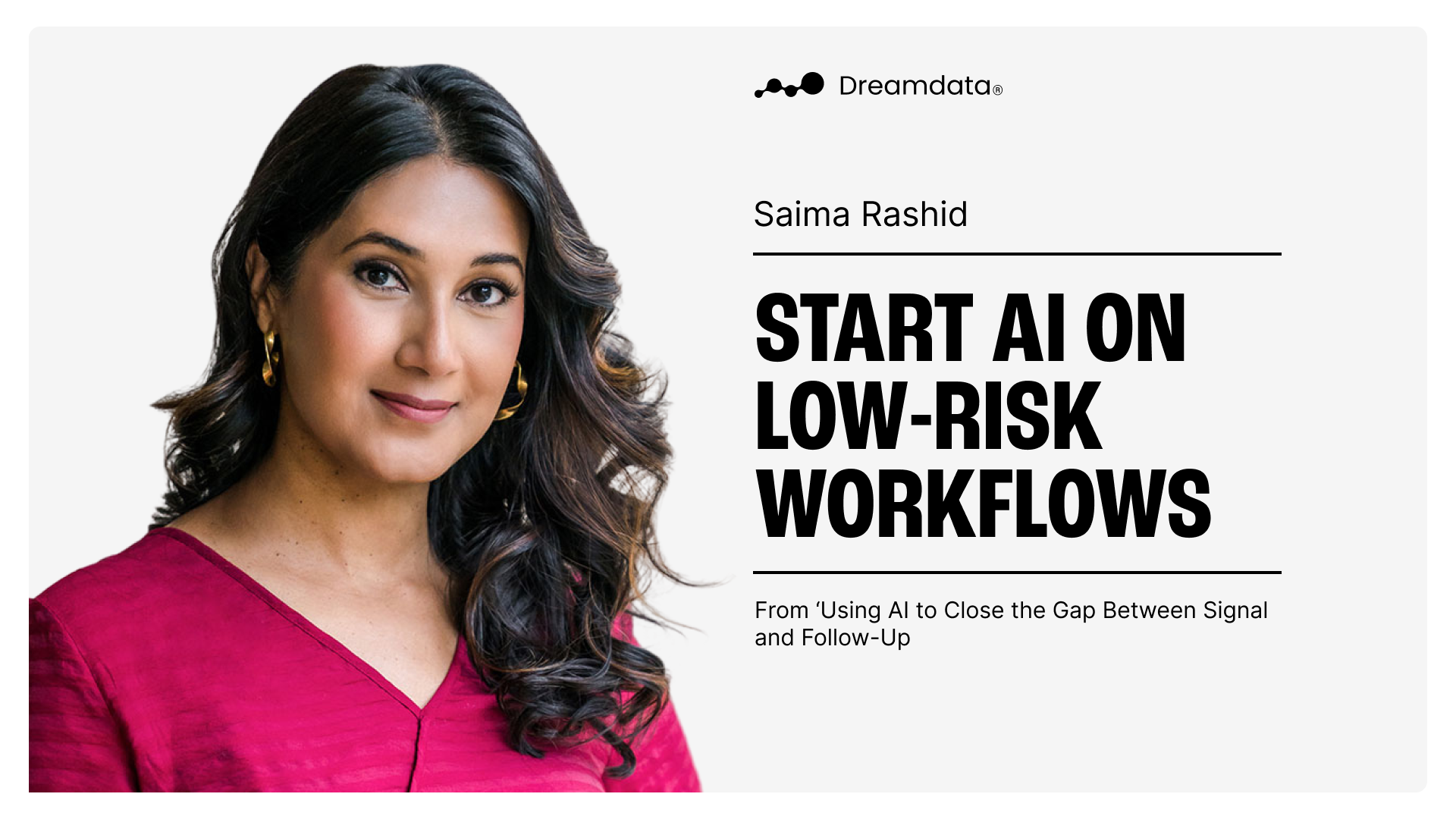
And when it comes to buyer-facing automation, she applies the same logic: “Start with either the easy repeatable use cases or the low risk ones and then build on that confidence.”
The focus on low risk is deliberate.
Early on, demand was coming in faster than the team could realistically respond. Some inbound requests and high-intent accounts would have gone untouched. Introducing AI agents meant those signals are acted on consistently, reducing variability.
Inbound requests are acknowledged immediately, high-intent accounts trigger structured outreach rather than sitting in dashboards, and closed-lost opportunities re-enter defined follow-up sequences without depending on someone to remember to revisit them.
Over time, consistency grows. In Saima’s case, AI agents became responsible for a significant share of new business – “25% of new business pipeline was coming from AI agents.”
That result came from tightening execution where it was already inconsistent, not from reinventing the go-to-market strategy.
For teams evaluating where to implement AI, the starting point is practical: identify where follow-up already breaks down and make it dependable. Once reliability improves in those areas, expanding into more complex workflows becomes a natural next step.
AI Scales What You Already Understand About Your Buyers
Once AI is supporting structured execution, the next step feels obvious: expand its role.
More accounts.
More workflows.
Broader coverage across the buying group.
But scale only improves outcomes when it reflects how buyers actually make decisions.
Saima emphasizes the importance of context. It’s not enough for an agent to reach one contact at an account. “You need to provide context to the agent so that it’s not just doing outreach to one person, it’s doing outreach to the seven people in your buying group in a way that meets them where they are in the moment and provides value to them.”

That shift from single-contact outreach to coordinated buying group engagement is critical.
B2B buying decisions involve multiple stakeholders, each responsible for different priorities. Progress happens as those stakeholders build confidence over time and that requires role-specific messaging, industry nuance, and a clear understanding of the problems each persona is responsible for solving.
AI can support that coordination at scale, but it depends entirely on the quality of the input it receives.
Nuance still comes from your positioning, your customer conversations, your closed-lost analysis, and a realistic view of how buying groups move through the journey.
Saima captures it directly: “If you multiply something by zero, it’s still zero.” Scaling weak messaging doesn’t improve it. And she adds, “you don’t want to be scaling things that we just think are important or talk a lot about ourselves and what we think is so great about us. Always put the customer at the center of what you’re producing.”

When AI is grounded in real buyer insight, it strengthens execution across the buying group: outreach reflects the right pain points, messaging aligns with actual objections, and engagement happens in a way that supports how decisions are made in reality.
When the grounding is missing, automation simply increases activity.
An execution layer amplifies what’s already there: a strong strategy becomes more consistent while a weak strategy becomes more visible.
The practical implication? Expanding AI across more workflows works best when the underlying messaging and buyer understanding are solid.
Conclusion
Pipeline performance reflects how consistently intent signals are acted on, how broadly buying groups are engaged, and how deliberately follow-up continues after initial interest.
In that equation, AI functions as a tool for making execution more reliable and structured across the funnel.
Saima’s approach to integrating AI centers on that layer of execution: strengthen follow-up where it already breaks down, make structured work more dependable, and only expand once messaging and buyer understanding are solid.
Ultimately, pipeline improves when execution becomes consistent.
About the speaker
Saima Rashid is the Chief Marketing Officer at Workhuman, where she leads global marketing with a human-first approach that spans brand, demand, and revenue operations. She has over two decades of experience in B2B marketing and has been recognized by Forrester for her work in AI-driven revenue marketing.
