
Why Slow Deal Progression is Often a B2B Positioning Problem
TL;DR: Positioning shows up in whether buyers move forward in the sales process. If prospects hesitate to agree to a clear next step after the first conversation, it signals that the case for change hasn’t landed. You can see that early in next-step conversion, website behavior, and sales conversations.
Slow deal progression is often treated as a pipeline problem.
Teams revisit follow-up cadences, review pricing, tighten qualification criteria, and add more marketing activities to “restore momentum.” But deals only progress when buyers decide to continue the conversation instead of sticking with what they currently use.
The next step in that process – a clear commitment to keep evaluating, involve others, or schedule a follow-up – is where positioning gets tested.
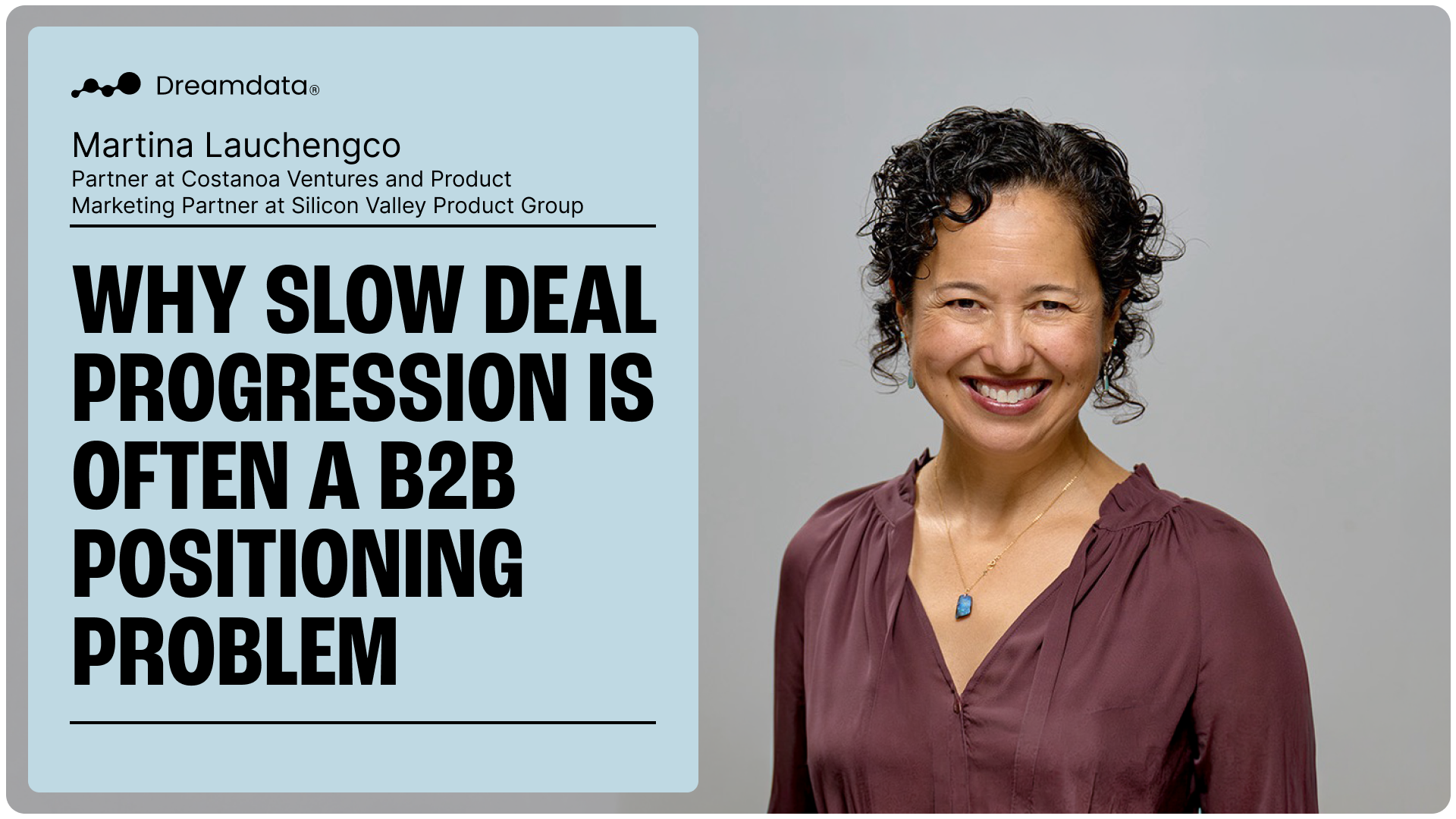
In a recent episode of the Attributed podcast, Martina Lauchengco, Partner at Costanoa Ventures and Product Marketing Partner at Silicon Valley Product Group, shared a practical way to evaluate positioning: observe what happens after the first conversation.
When someone agrees to an initial conversation but doesn’t commit to continuing, they don’t see enough reason to disrupt what they’re already doing. That hesitation is feedback.
Below, we break down how to read that signal across conversations, website behavior, and sales language. You can also listen to the full conversation with Martina here.
Positioning is Measured in Next Steps
You can generate traffic, book first meetings, and even have a “great conversation.”
But if buyers don’t agree to the next step of the sales process (ie. involving additional stakeholders, scheduling an in-depth demo, defining a proposal), that’s where positioning flaws gets exposed.
As Martina puts it: “If you’ve earned the right to have a conversation, if people aren’t engaging in the next step, then there’s something wrong in your value proposition and how you’re saying it.”
That’s uncomfortable, because most B2B teams treat first-meeting conversion as a sales metric rather than a positioning signal. Especially in early-stage or warm-network environments, you’ve already cleared the hardest hurdle: attention. Someone agreed to talk and they were curious enough to lean in.
If only two out of ten of those conversations progress, it’s tempting to call that “not bad”.
But Martina argues that you should expect something closer to 40 - 70% of the first conversations moving to a defined next step.
Not closed-won. Simply an agreement to keep going.
When that number is consistently low, buyers don’t feel confident enough to move forward. That’s a signal to refine how you frame the problem and the outcome.
Positioning improves when you treat that hesitation as input and adjust your message accordingly.

Why Conversations Stop Advancing
When buyers hesitate, the instinct is to adjust tactics: tweak pricing, tighten qualification, add another follow-up touchpoint.
And sometimes that helps. But often it doesn’t.
Because in B2B, you’re rarely introducing something entirely new. You’re asking someone to replace an existing tool, process, or way of working that already exists and feels familiar to the market. As Martina says, “you’re displacing a behavior … an existing technology or way of getting things done that feels comfortable.”
Comfort is powerful. And “good enough” is powerful.
Understanding what you do isn’t the same as wanting to change.
That gap between intellectual agreement and organizational urgency is where deals stall.
When buyers consistently agree to continue speaking with you, your positioning is strong enough to make a change feel justified. When they don’t, they’re unconvinced, not simply confused.
That distinction matters.
Your Website Tests Your Positioning Early
Positioning used to feel static.
You’d define it in an internal workshop, rolled it out across messaging, and fingers were crossed that the market actually agreed. Once it was printed on the box, you were stuck with it.
That’s no longer how it works.
“Today, the process can be more dynamic and messy,” Martina explains, “because you have a market that will react immediately and you can iterate on it.”
That immediacy is an advantage if you’re willing to read it correctly.
Buyers don’t wait six months to tell you they’re unconvinced. They show you quickly through exit rates, time on site, click-through rates, and whether they move beyond the homepage at all.
And this is why Martina calls the website “the early and easy tell.”

If six out of ten visitors leave your homepage immediately, that’s the market reacting.
Bounce rates that don’t improve after a messaging revision or click-through rates that stay flat despite clearer copy often point to something deeper than layout or channel quality. They show that buyers don’t see enough reason to explore further.
And “not exploring further” is the earliest version of a stalled deal.
Because long before someone speaks to sales, they’re already deciding whether your point of view feels relevant or worth disrupting their current setup for.
The foundational question isn’t “does this page convert?”
It’s “does this make change feel necessary?”
If the answer is no, no amount of downstream optimization will create momentum later.
Sales Calls Show Whether Your Positioning Holds Up
You can see positioning in your metrics and hear it in your sales calls.
Spend enough time inside your company and it’s easy to fall in love with how you talk about your product. The narrative gets cleaner. The value proposition sounds sharper. Internally, it makes perfect sense.
But as Martina points out, “it’s not necessarily the way the world either sees us or can comprehend what we mean.”
Sales calls expose that gap – you hear it in the questions buyers ask, the pauses before they commit, and how often they ask you to clarify what should have been obvious.

If your value proposition needs translating before it’s understood, conversations slow. Buyers hesitate, not because they disagree, but because they don’t immediately recognize themselves in what you’re saying.
And recognition is what earns the next step.
Hesitation shows up as friction (slightly longer cycles, extra stakeholders pulled in to “take a look”, more explanation) rather than a dramatic drop-off.
That’s positioning under strain.
Listen for the Language That Earns the Next Step
Sales operates in a constant feedback loop. They feel confusion and resonance in real time. Over time, strong salespeople adapt their language to what buyers actually respond to.
They’re closest to the reaction.
That’s why Martina suggests listening in on sales calls: “You can discover a lot of gems from really strong salespeople who are discovering a lot of the more human ways of articulating value.”
It’s tempting, however, to rely on AI summaries and neatly categorized trend reports from these calls. But positioning isn’t only in the obvious objections. It shows up in the “gory details”:
In how buyers describe their current reality.
In what they’re reluctant to change.
In the need to feel understood before hearing a better approach

When buyers consistently ask you to clarify or rephrase your value n simpler terms, that’s friction. And when certain explanations consistently lead to further conversation, pay attention.
Over time, those patterns should reshape how you talk everywhere else – on your website, in your campaigns, and in your pitch.
The best positioning isn’t necessarily the most polished version of your story. It’s the version buyers repeat back to you and feel comfortable acting on.
Conclusion
Forward motion is the clearest test of positioning. When buyers agree to the next step, your message has made change feel justified. When they hesitate, the case for change hasn’t landed.
They’re unconvinced, not confused.
You don’t have to wait for closed-won data to see this. Feedback shows up early: in next-step conversion, in website engagement, and in conversations.
Read those signals before you try to fix your pipeline.
About the Speaker
Martina Lauchengco is a Partner at Costanoa Ventures, where she advises early-stage technology companies on go-to-market strategy and positioning. She also serves as a Product Marketing Partner at Silicon Valley Product Group, serving insights with companies ranging from startups to Fortune 500s.
Her career spans more than 25 years in product marketing and product management, including leadership roles at Microsoft, Netscape, and Loudcloud, and she is the author of LOVED: How to Rethink Marketing for Tech Products.
